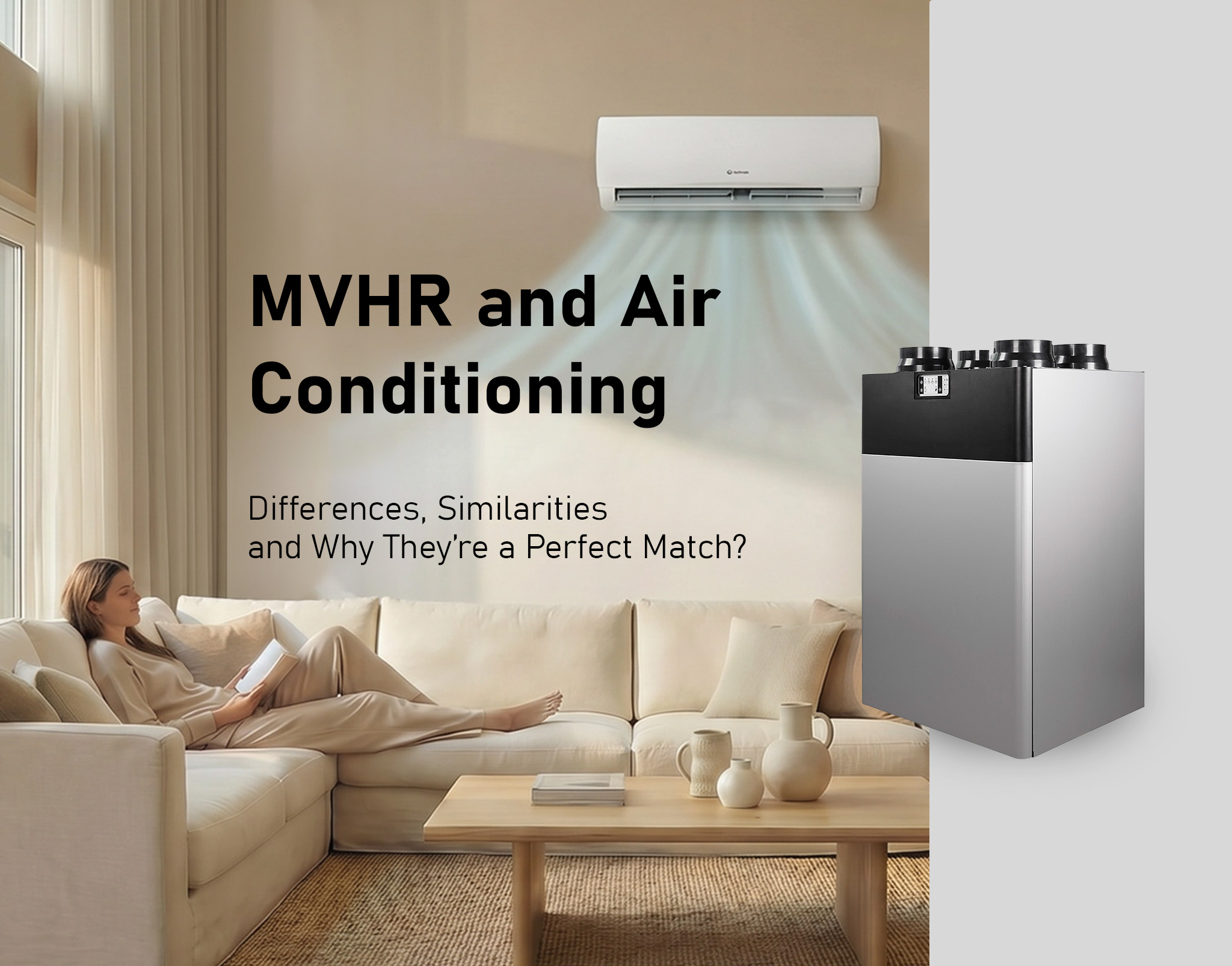
In modern, energy-efficient construction, the concepts of heat recovery ventilation and air conditioning frequently appear side by side, which often leads to the mistaken assumption that they are interchangeable solutions. In reality, they are two independent HVAC systems with entirely different purposes. Whereas mechanical ventilation with heat recovery provides continuous exchange of stale indoor air for fresh outdoor air, air conditioning is responsible for the active thermal treatment of the air already circulating within a space. Understanding the differences between them – and the principles of their synergy – is the key to creating an efficient, economical, and fully comfortable building or residential property. Below we explain how both solutions work, why a heat recovery unit cannot replace an air conditioner on hot days, and why combining the two represents the highest-return investment available.
Key information:
- Two distinct functions: Heat recovery ventilation exchanges stale indoor air for fresh outdoor air and recovers energy from the exhaust stream, whereas air conditioning actively cools or heats the air already present within the room (recirculated air).
- Heat recovery does not air-condition: Features such as summer bypass (free cooling) assist with natural temperature reduction during the night, but a heat recovery unit has no compressor and cannot replace the active cooling delivered by an air conditioner.
- Lower electricity consumption: Heat recovery ventilation (particularly with an enthalpy heat exchanger) pre-cools or pre-heats incoming outdoor air and blocks the ingress of moisture, meaning the air conditioner has less work to do and consumes less electricity.
- Order of installation works: Heat recovery ventilation must be planned at the design stage or during a major refurbishment (it requires the routing of large-diameter ductwork), whereas air conditioning (e.g. split systems) can be added relatively easily at a later stage.
Heat recovery and air conditioning are not the same thing
How does heat recovery work?
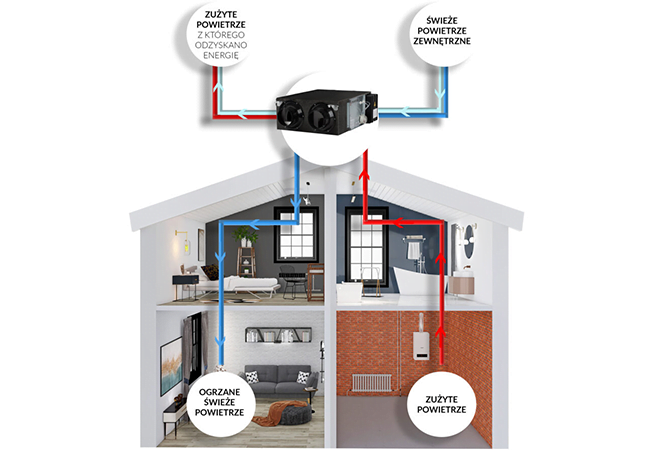
Heat recovery units from the INSPIRO, INSPIRO BASIC and VERTIC series physically exchange stale indoor air for fresh air drawn from outside. This is therefore a process of continuous air exchange, not merely air treatment. At the same time, the heart of the unit (the heat exchanger) recovers a significant proportion of the energy contained in the exhaust air. This solution dramatically reduces heat losses and maximises the ventilation efficiency of the building.
How does air conditioning work?
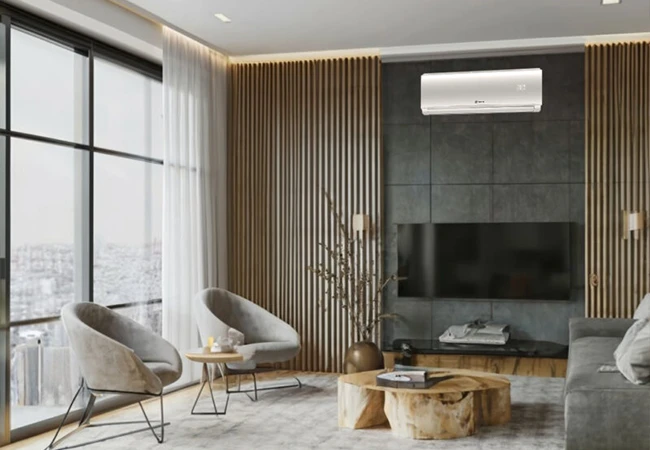
Wall-mounted air conditioners, such as the VESPER series, operate by thermally treating recirculated air. The unit draws in air already present in the room and then (using a refrigerant) actively changes its temperature. Depending on the selected mode, the air conditioner cools, heats, or dehumidifies the air. It does not, however, supply fresh air from outside.
Does heat recovery cool? Debunking the biggest myth in the HVAC industry
The short answer is: no, heat recovery ventilation does not actively cool air. This is one of the most common misconceptions on the market, arising from the erroneous identification of a ventilation unit with an air conditioner. Although a heat recovery unit will not drastically lower the temperature in an overheated building by itself, it does possess intelligent mechanisms that significantly improve thermal comfort and assist in combating summer heat.
The role of automatic bypass on summer nights
The automatic bypass in a heat recovery unit allows the heat exchanger to be bypassed during summer, admitting cooler outdoor air into the building (typically at night). This mechanism enables so-called free cooling, i.e. free, natural cooling of the premises. It should be noted, however, that this does not replace conventional air conditioning. A heat recovery unit with bypass has no compressor and does not actively cool the airstream; it simply takes advantage of favourable outdoor temperature conditions to naturally reduce the temperature within the building.
Enthalpy heat exchanger and summer humidity
The use of an enthalpy heat exchanger in INSPIRO heat recovery units significantly reduces the ingress of hot, humid outdoor air on warm days. Thanks to innovative polyethylene-graphene technology, the unit retains a proportion of moisture, which genuinely improves comfort and eliminates the unpleasant sensation of stuffiness in rooms.
Active cooling nonetheless remains the responsibility of the air conditioner. The heat recovery unit alone is insufficient if the objective is a rapid and drastic reduction in temperature. An air conditioner is essential for this purpose, as it is the only device that guarantees a real, perceptible reduction in temperature and effective dehumidification of the indoor air.
Why do heat recovery and air conditioning make the perfect pairing?
Lower electricity bills (the air conditioner “works less hard”)
Heat recovery ventilation has a direct influence on reducing electricity bills and lowering the energy consumption of the air conditioning system. In summer, the mechanical ventilation unit with heat recovery pre-cools the hot supply air entering the building, utilising the coolness of the exhaust air extracted from air-conditioned rooms.
In practice, this means that the air conditioner has considerably less work to do. The compressor does not need to operate at maximum capacity, since the system receives air that has already been pre-treated. The reduced load on the system translates directly into lower operating costs. In addition, the enthalpy heat exchanger prevents the ingress of moisture from outside, meaning the air conditioner consumes less energy on the energy-intensive task of dehumidification (particularly on humid summer days).
Uniform temperature distribution and excellent air quality parameters
Air conditioning efficiently achieves the set temperature, whilst mechanical ventilation supplies fresh air and removes stale air, continuously maintaining a low CO₂ level. In practice, the building owner gains not only thermal comfort (courtesy of the air conditioner) but also a perfect microclimate and healthy air (courtesy of the heat recovery unit).
Mechanical ventilation supplies fresh air and removes stale air, continuously maintaining a low CO₂ level. In practice, the building owner gains not only thermal comfort (courtesy of the air conditioner) but also a perfect microclimate and healthy air (courtesy of the heat recovery unit).
Parameter comparison: Heat recovery vs. Air conditioning – key differences
Although both systems belong to the HVAC sector, they fulfil entirely different functions, and their combined operation delivers the best results.
| Function / Parameter | Heat recovery (Mechanical ventilation) | Air conditioning |
| Primary purpose | Exchanges stale indoor air for fresh outdoor air | Thermally treats the air within the room |
| Energy management | Recovers energy from exhaust air | Actively cools or heats air, consuming electrical energy |
| Health impact | Reduces CO₂ levels and improves air quality | Maintains the set temperature |
| Cost savings | Reduces ventilation energy losses | Consumes energy in exchange for thermal comfort (though heat recovery optimises this) |
| Effect on humidity | Regulates relative humidity levels within the room to a certain extent and protects against stuffiness | Effectively dehumidifies air during cooling. Features a dedicated dehumidification function. |
| Summer operation | Supports comfort (bypass and free cooling) | Rapidly reduces temperature during hot weather |
| Can it be replaced? | Does not replace air conditioning | Does not replace a ventilation system |
In modern, airtight construction, both systems complement one another. Heat recovery minimises energy losses, whilst air conditioning ensures the thermal comfort of the building owner.
What to install first and is it possible to forgo one of the systems?
Heat recovery ventilation must be planned and installed first (particularly at the construction stage or during a major refurbishment). Ventilation ducts, penetrations, distributors of considerable diameter, and the location of the central unit must all be integrated into the building structure. Retrofitting a duct network at a later stage is invasive, difficult, and costly.
Air conditioning (e.g. split or multi-split systems) is considerably easier to add at a later stage. It requires the routing of slender refrigerant lines, condensate drainage, and the installation of units, which is architecturally far less disruptive than routing ventilation ductwork.
Is it possible to forgo one of the systems? Technically yes, but full comfort is then compromised. The absence of heat recovery ventilation means high CO₂ concentrations or heat losses with traditional window ventilation (which conflicts with the WT 2021 regulation). The absence of air conditioning, on the other hand, carries the risk of the building overheating in summer. Both systems are therefore a fundamental requirement of modern construction.
Frequently Asked Questions (FAQ)
Does air conditioning dehumidify the air, and how does a heat recovery unit with an enthalpy heat exchanger counteract this?
Yes, during cooling the air conditioner dehumidifies the air: moisture condenses on the cold heat exchanger of the indoor unit and drains away as condensate. A heat recovery unit with an enthalpy heat exchanger provides a solution to this. By transferring water vapour between airstreams (without mixing odours or contaminants), the enthalpy exchanger limits excessive drying of interiors in winter and, in summer, blocks the ingress of sticky, hot moisture from outside.
How are both systems controlled?
Control can be carried out locally, remotely via smartphone, or centrally through building management systems (BMS) using, among others, the Modbus protocol.
- VESPER air conditioners can be operated using a dedicated remote control or via Wi-Fi through the Smart Life application, with precise operating schedules set to your requirements.
- VERTIC heat recovery units feature two built-in physical control panels (a standard panel and an advanced panel concealed behind the inspection cover) and can be integrated into a Modbus system. They can additionally be fitted with a Wi-Fi module.
- INSPIRO / INSPIRO BASIC heat recovery units are controlled via clear control panels (BASIC, SMART or PREMIUM) and BMS (via the Modbus protocol).
Summary – a quality investment that pays for itself
A modern, comfortable building today is no longer a choice between air conditioning and heat recovery ventilation, but a considered combination of both technologies. Heat recovery provides fresh air, energy-efficient ventilation, and a healthy microclimate, whilst air conditioning guarantees full control over thermal comfort in both summer and winter.
From an engineering perspective, this is a high-return investment (ROI). Properly selected and integrated HVAC systems allow devices to reduce the load on one another. As a result, they operate more efficiently, more quietly, consume less energy, and have a longer service life.
Contact the Reventon experts!
Are you designing a modern building and looking to avoid costly mistakes?
Contact our technical adviser – we will help you select a heat recovery system and air conditioner precisely matched to the volume of your building and its energy requirements. Browse our range of heat recovery units and air conditioners.