
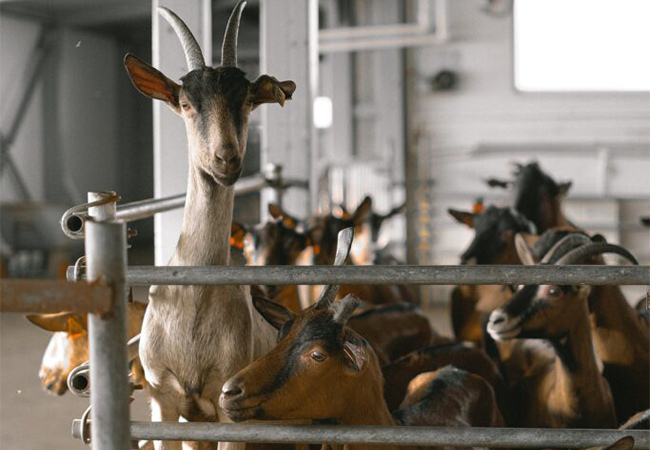
Maintaining the correct temperature is one of the most important factors influencing the results and efficiency of animal husbandry. For this reason, the heating installation plays a significant role in livestock buildings and must be given particular attention at the design stage.
How to heat a poultry house, stable, or pig unit?
The growth and development of animals, depending on species or breed, is often only possible at relatively high temperatures (compared with the temperature requirements of spaces intended for human occupancy). At the design stage, account must be taken of the fact that buildings such as stables, poultry houses, pig units, and cattle sheds are characterised by considerable dust levels and the presence of a chemically aggressive environment associated with the activities carried out within them. The method and location of installation of the heating equipment are also extremely important. An LPHW unit heater – which is what we are discussing here – should be installed in a location that will not cause draughts and will not generate excessive noise, to which animals may be sensitive.
Which air unit heaters are best suited to agriculture?
In practice, a convective system based on LPHW unit heaters supplied from a central heat source performs excellently in many cases. These units enable warm air to be directed directly into the animals’ living zone and provide additional air circulation that supports the operation of the ventilation installation. The unit heaters must, however, be designed for operation in corrosive and often heavily dust-laden environments, such as those in the FARMER series, which feature a heat exchanger coated with an LCE coating that protects the unit against the adverse effects of the environment. The unit heater features a fan with motor ingress protection to IP 54 or IP 66, with impeller blades manufactured from plastic or steel, depending on the model. A further characteristic of FARMER series unit heaters is the greater fin-to-heat-exchanger spacing compared with standard unit heaters, which means the heat exchanger does not become blocked as frequently and can be easily cleaned using compressed air.
FARMER – the best units for the agricultural sector

FARMER HCF IP 54 and FARMER MC unit heaters are equipped with a three-speed AC motor, the operation of which can be controlled via an HC3S speed controller with thermostat to IP 30 or an HMI controller to IP 20. For control of the FARMER HCF IP 66 with a single-speed AC motor, an HC speed controller is provided, enabling voltage-based regulation to IP 54, or an HMI SINGLE controller to IP 20. The solution to the low ingress protection rating of HMI series controllers is an external temperature sensor to IP 68, supplied with the unit – it is sufficient for the sensor alone to be installed in the stable, poultry house, pig unit, or cattle shed, and based on its readings the controller installed in a “safe” location will control the operation of the heating equipment. HMI controllers and the HC3S regulator also allow control of the actuated valve that cuts off the supply of heating medium to the unit heater.