In winter, condensation forms on the ceiling and you can smell ammonia at the door. In summer, the animals pant and performance drops even though the feed hasn’t changed. The right ventilation in livestock buildings can solve both problems.
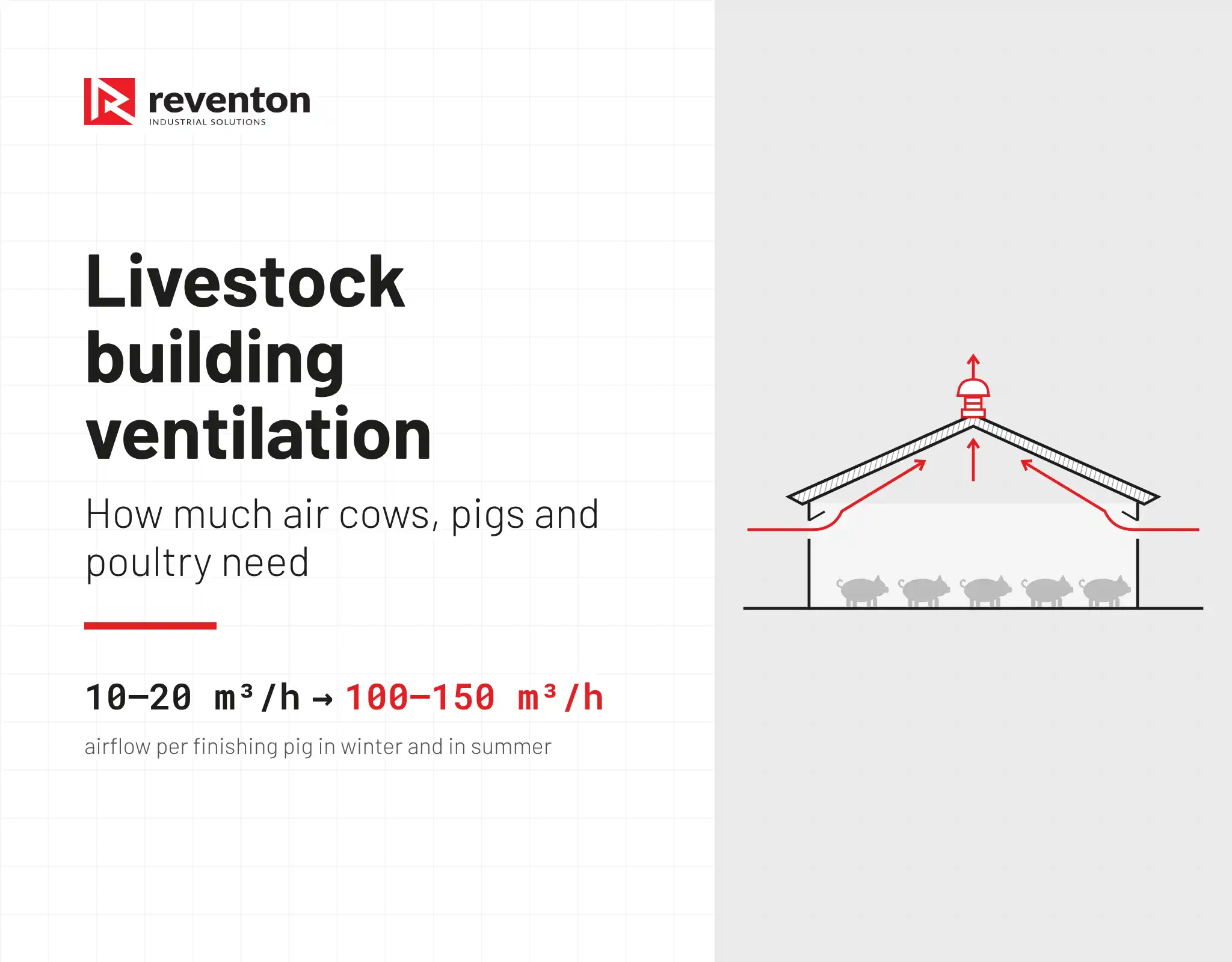
How? Ventilation removes heat, water vapour and harmful gases. In an insulated building with mechanical ventilation, you usually need 8–10 times more air in summer than in winter.
Poor ventilation rarely shows itself straight away. You see it later in disease, poorer weight gain and vet bills. This article explains how many m³/h cows, pigs and poultry need, what gas concentrations regulations allow and how to calculate ventilation for your own building.
Key takeaways
- In an insulated building you need 8–10 times more air in summer than in winter. That is why maximum capacity is sized for summer and the control range for winter
- Under Polish law, ammonia in pig houses and calf housing must not exceed 20 ppm, carbon dioxide 3,000 ppm and hydrogen sulphide 5 ppm (regulation of the Polish Ministry of Agriculture of 15 February 2010)
- Air inlets are installed on the side walls 2–3 m above the floor, and the airflow must not blow directly onto the animals
- Dairy barns usually do well with hybrid ventilation; finishing pig houses and broiler houses need mechanical ventilation with controls
- Mechanical ventilation in a livestock building must have a failure alarm and a back-up ventilation system
Why is livestock building ventilation essential?
Livestock building ventilation is the exchange of air that removes the heat, moisture, gases and dust produced by animals and manure and replaces them with fresh air. It is essential because animals produce all of these around the clock, and in a closed building they have nowhere to disperse. Without air exchange, their concentration keeps rising.
Moisture shows the scale well. An adult dairy cow gives off more than ten litres of water as vapour every day, so a barn with 100 cows produces over a thousand litres a day. That water has to get outside; otherwise it condenses on the ceiling and walls or stays in the bedding.
Good ventilation does five things:
It keeps air temperature and humidity at levels that keep animals comfortable
Cows, pigs and poultry give off a lot of heat and water vapour. If ventilation does not remove it, the animals overheat and water condenses on the walls and ceiling.
It removes harmful gases
Several harmful gases build up in the building: ammonia, hydrogen sulphide, methane and carbon dioxide. They can harm the health of both animals and people.
It reduces disease
Pathogens spread more easily in stagnant air. Air exchange carries them outside along with the dust.
It improves animal welfare and production results
An animal that is neither too hot nor short of fresh air eats more and performs better: cows give more milk and finishing pigs gain weight faster.
It lowers the ammonia concentration inside the building
More fresh air dilutes the ammonia inside the building, but it does not reduce the amount released into the atmosphere. Emissions are reduced with lower-protein feed, frequent manure removal and exhaust air scrubbers.
What do production and staff gain?
A better indoor climate means higher milk yields, faster weight gain in finishing pigs and fewer vet visits. Heat is the best-documented example: a heat-stressed cow produces 17–35% less milk and eats 35–48% less feed (Osei-Amponsah et al., 2020, cited in Habimana et al., 2023).
Staff breathe the same air as the animals. When air quality is poor, headaches, difficulty concentrating and occupational allergies follow. In the USA and the UK, the recommended occupational exposure limit for ammonia is 25 ppm over an 8-hour shift (Wathes et al., 2003).
Ammonia, carbon dioxide and hydrogen sulphide: what concentrations do regulations allow?
In Poland, specific limits apply to calves and pigs: ammonia up to 20 ppm, carbon dioxide up to 3,000 ppm and hydrogen sulphide up to 5 ppm. For broilers kept at a stocking density above 33 kg/m², the same ammonia and CO₂ limits are measured at the level of the birds’ heads. Ppm (parts per million) is a unit of concentration: 20 ppm means 20 molecules of gas per million molecules of air.
| Animal group | NH₃ | CO₂ | H₂S | Other requirements | Legal basis (Poland) |
| Calves | up to 20 ppm | up to 3,000 ppm | up to 5 ppm | none | Dz.U. 2010 No. 56, item 344, § 18 |
| Pigs | up to 20 ppm | up to 3,000 ppm | up to 5 ppm | noise up to 85 dB | as above, § 26 |
| Broilers, stocking density above 33 kg/m² | up to 20 ppm (at head height) | up to 3,000 ppm (at head height) | none | average humidity up to 70% over 48 h when it is below 10°C outside; inside no more than 3°C above the outside temperature when it exceeds 30°C in the shade; ventilation plan | as above, § 37; Directive 2007/43/EC, Annex II |
| Laying hens | no figures | no figures | no figures | parameters “not harmful to the animals” | as above, § 8 |
| Adult cattle | no figures | no figures | no figures | parameters “not harmful to the animals” | Dz.U. 2010 No. 116, item 778, § 7 |
Where the regulations give no figures, the limits for calves and pigs are a sensible benchmark for cows and laying hens too. Outside Poland, national rules apply, so check the limits that are in force in your country.
Does mechanical ventilation need an alarm?
Yes. If a livestock building has mechanical or automatic ventilation, it must be connected to an alarm that signals a failure and to a back-up ventilation system (Council Directive 98/58/EC). In a broiler house, fans stopping on a hot day can cause deaths within a short time.
What determines how much air a building needs?
The amount of air depends on the species, age and weight of the animals, the planned stocking and the season. In winter, ventilation has to remove moisture and gases with as little heat loss as possible. In summer, it has to remove heat and protect the animals from heat stress.
The values in the three tables below are indicative ranges based on our previous selections, intended for initial sizing. The design for a specific building also takes into account the climate, insulation and housing system.
How much air do cows need in a barn?
Based on our previous selections, a dairy or beef cow needs about 20–40 m³/h of air in winter and 300–600 m³/h in summer. The winter value is the lower limit. In a closed barn, the minimum comes from the moisture and CO₂ balance of the specific building. These values are indicative.
| Parameter | Winter (minimum) | Summer (maximum) | Purpose |
| Airflow per animal | 20–40 m³/h | 300–600 m³/h | removing moisture and ammonia in winter, cooling in summer |
| Air changes | from 4 per hour | up to 40 per hour | depending on building volume and weather |
| Air velocity at animal level | up to 0.3 m/s | higher when fans cool the animals | no draughts in winter, more heat dissipation in summer |
Dairy cows start producing less milk when the average temperature exceeds 22°C, which corresponds to a THI of 69. The THI (temperature-humidity index) combines air temperature and humidity into one number that describes the heat load on animals. Barns are usually tall, open buildings, so natural ventilation supplemented with fans for summer is often enough.
How much air does poultry need?
In broiler houses, the requirement is calculated per kilogram of bird weight; in laying hen houses, per bird. Broilers need 0.3–0.6 m³/h per kg in winter and 4–6 m³/h per kg in summer. The breed management guide gives the exact values for a given flock.
| Group | Winter (minimum) | Summer (maximum) |
| Broilers | 0.3–0.6 m³/h per kg of body weight | 4–6 m³/h per kg of body weight |
| Laying hens | 0.5–1.0 m³/h per bird | 6–8 m³/h per bird |
In winter, poultry house ventilation mainly has to remove excess moisture and ammonia. In summer, a broiler house needs very fast air exchange, which is why large farms use tunnel ventilation. With poor ventilation, CO₂ and ammonia levels rise, leading to suffocation, deaths and cannibalism.
How much air do pigs need?
A finishing pig needs 10–20 m³/h of air in winter and 100–150 m³/h in summer. These values are on the safe side. Standards and guidelines in European countries assume 60–120 m³/h per finishing pig in summer, and the German standard DIN 18910 gives 99 m³/h for a 100 kg pig (Schauberger et al., 2020). Piglets need less air but are very sensitive to draughts and temperature swings.
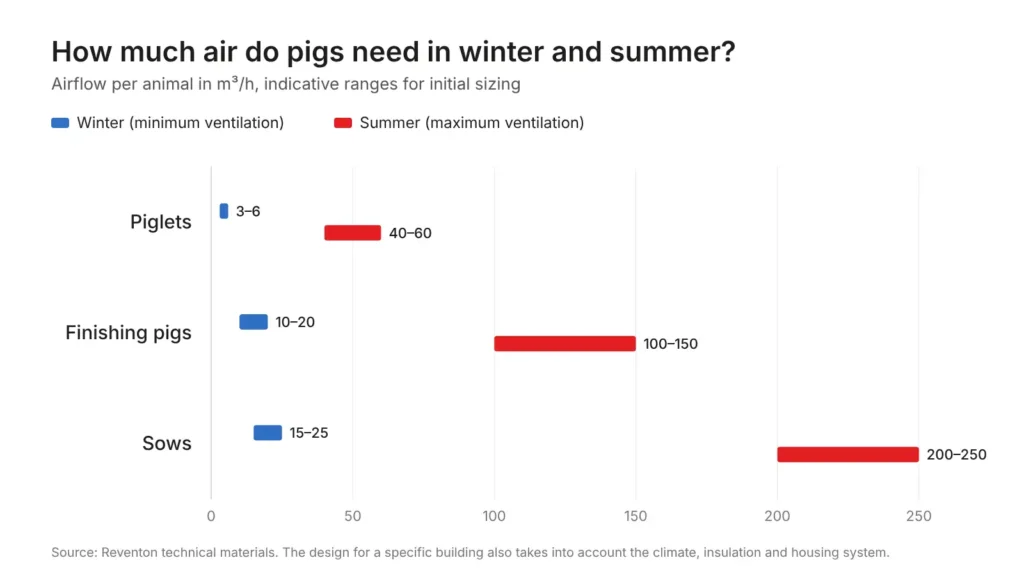
| Group | Winter (minimum) | Summer (maximum) | Watch out for |
| Piglets | 3–6 m³/h per animal | 40–60 m³/h per animal | very sensitive to draughts and temperature |
| Finishing pigs | 10–20 m³/h per animal | 100–150 m³/h per animal | a lot of heat and ammonia |
| Sows | 15–25 m³/h per animal | 200–250 m³/h per animal | special care around farrowing |
Pig houses have high stocking densities and gas emissions, so natural ventilation is rarely enough.
What happens when ventilation fails?
The effects of poor ventilation build up slowly. First in herd health, then in production and finally in costs and the condition of the building.
| Species | Diseases and symptoms more common with poor ventilation | Effect on production |
| Cattle | pneumonia, respiratory irritation, lowered immunity; watery eyes, sneezing and nasal discharge, especially in calves | lower milk yield |
| Pigs | PRRS, APP, coughing | poorer feed conversion, slower growth |
| Poultry | respiratory infections, higher mortality in hot weather | lower daily weight gain |
Poor air does not cause these diseases on its own. PRRS is caused by a virus and APP by a bacterium. Ammonia, dust and moisture do, however, irritate the airways, and pathogens pass more easily from animal to animal in stagnant air. Research has not yet settled how strongly ammonia alone aggravates respiratory disease in pigs and poultry. Bear in mind, too, that poor ventilation in summer also leads to heat stress and dehydration.
High humidity and lack of air movement encourage mould, bacteria and flies. Condensation and wet bedding lead to hoof infections and fungal skin diseases. Draughts, in turn, are considered one of the main risk factors for tail biting in pigs. Every additional illness means more antibiotics, higher costs and a risk of residues in milk or meat.
What does it cost?
Poor ventilation raises costs in several places at once. Treatment costs go up, and more feed is needed per kilogram of weight gain. Output of milk, eggs or meat falls. On top of that come repairs to damp walls, corrosion of the structure and more frequent bedding changes.
Natural, mechanical or hybrid ventilation?
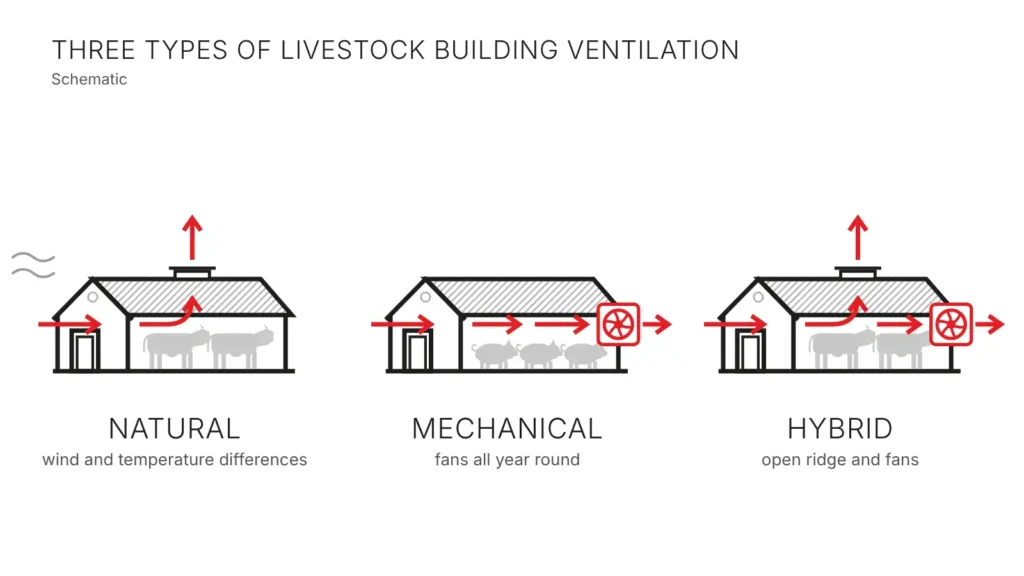
Ventilation systems in livestock buildings fall into three types. Natural ventilation, also called gravity ventilation, relies only on wind and temperature differences. Mechanical ventilation moves air with fans all year round. Hybrid (mixed) ventilation combines openings in the walls and ridge with fans that switch on when the natural draught is not enough. The right choice depends on the species, housing system, location of the building and how far it can be modified.
| Type | How it works | Where it works well | Limitations |
| Hybrid | natural inlets and an open ridge plus wall fans, e.g. switched on by sensors in summer | in all weather; flexible control and lower power consumption than a fully mechanical system | requires careful design and calibration; older buildings need adapting |
| Mechanical | extract or supply fans, often controlled by temperature, humidity and gas concentration | intensive farming, full climate control all year round, automation | higher installation and service costs; needs cleaning, a power supply and a back-up system |
| Natural (gravity) | wall inlets, exhaust through the ridge, towers or chimneys; driven by wind and the stack effect | tall, open buildings, e.g. loose-housing barns; uses no electricity and is simple to run | performance changes with the weather; hard to control; usually too weak for poultry and pig houses |
Mechanical ventilation comes in three variants. In tunnel ventilation (poultry and pig houses), air flows along the full length of the building. In negative-pressure systems, exhaust fans remove stale air through walls or chimneys, and fresh air enters through inlet flaps. In positive-pressure systems, fans push air in and the exhaust air leaves passively.
Which ventilation systems suit cows, pigs and poultry?
| Animals | Recommended system |
| Dairy cows | hybrid (natural with fans) |
| Finishing pigs | mechanical, roof or tunnel |
| Broilers | mechanical tunnel ventilation with sensors |
Not sure which layout suits your building? Get in touch and we’ll help you choose equipment for your building and herd.
How to size livestock building ventilation step by step
Sizing starts with the number and type of animals, because they determine how much air needs to be exchanged in summer and winter. Building volume and air changes are used to check the result and plan the layout of the equipment.
- Take the planned stocking and calculate the required airflow for winter and summer: number of animals × value from the table.
- Calculate the building volume and check how many air changes per hour this airflow gives.
- Determine the total fan capacity at the operating point, i.e. against the resistance of the shutters, inlets and building.
- Choose the system type: natural for tall, open buildings; mechanical for high stocking densities and gas emissions; hybrid when you need flexibility.
- Plan the position of the inlets and exhausts.
- Select the industrial fans from.
- Add shutters, controls, an alarm and back-up ventilation.
Example: a pig house for 500 finishing pigs
Let’s take a pig house for 500 finishing pigs with exhaust ventilation. According to the table, summer requires 500 × 100–150 m³/h, i.e. 50,000–75,000 m³/h, and winter 500 × 10–20 m³/h, i.e. 5,000–10,000 m³/h. For sizing, we take the upper summer value of 75,000 m³/h plus at least 10% reserve at free air delivery, i.e. about 82,500 m³/h.
For exhaust through a side wall, we compare three variants of FR-BS wall-mounted extractor fans with EC and EC-EE motors. The AC version (up to 1,550 m³/h) is too small for a building of this size: you would need about 50 fans.
| Variant | Model | Max. airflow per fan | Number | Total airflow | Reserve | Motor power | Noise at 1 m | Supply |
| A, EC motor | FR-630-BS EC | 23,850 m³/h | 4 | 95,400 m³/h | 27% | 4 × 2,600 W = 10.4 kW | 86 dB | 3~400 V |
| B, EC-EE motor | FR-800-BS EC-EE | 21,000 m³/h | 4 | 84,000 m³/h | 12% | 4 × 1,390 W = 5.6 kW | 75 dB | 3~400 V |
| C, EC-EE motor | FR-630-BS EC-EE | 10,800 m³/h | 8 | 86,400 m³/h | 15% | 8 × 420 W = 3.4 kW | 69 dB | 230 V |
Data from the technical documentation of the FR-BS EC and FR-BS EC-EE fans.
Variant C uses the least power: eight smaller EC-EE fans have a total of 3.4 kW, and each fan is the quietest. The trade-off is more wall openings and shutters. Variant B delivers a similar airflow from four fans at 5.6 kW, but has the smallest reserve, so the fan curve may show that a fifth one is needed.
Variant A has the largest reserve, but its motors have almost twice the power of variant B. A single variant A fan also produces 86 dB at 1 m, while the Polish noise limit for pig houses is 85 dB, so check what level reaches the pens.
In winter, at 5,000–10,000 m³/h, one or two fans at low speed are enough, because EC and EC-EE motors are steplessly controlled. The others stand still with their shutters closed.
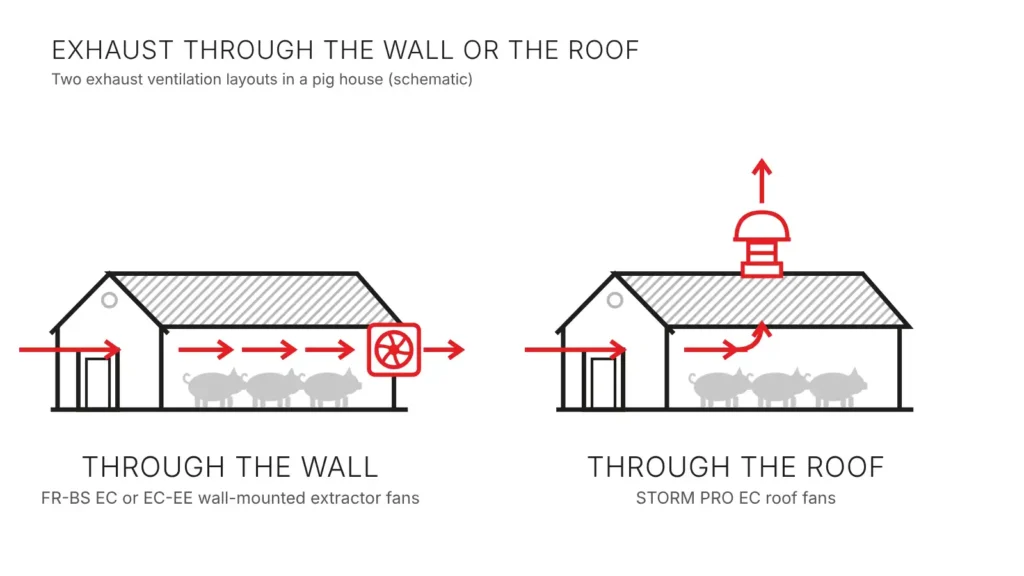
Exhausting through the roof is the other option. With the same assumptions, you would need six STORM PRO 500 EC roof fans (6 × 13,800 m³/h = 82,800 m³/h, 10% reserve) with a total motor power of 18 kW. The smaller STORM PRO 450 EC fans total 12 × 1,006 W = 12.1 kW, but you need twelve of them. At free air delivery, both roof variants therefore have 2–5 times the motor power of variants B and C.
How did we calculate this? We took the per-animal requirement from the finishing pig table and the maximum airflow and rated power from the documentation (i.e. at free air delivery). The 10% reserve is our starting assumption, not a calculated result. The operating point is the airflow a fan delivers against a specific system resistance. You read it from the fan curve in the documentation for the expected resistance of the shutters, inlets and walls.
Only the fan curves show how roof and wall fans behave against system resistance. For livestock buildings and aggressive environments, always check the equipment selection with our technical department to make sure the fan can operate in that environment.
Send us the building dimensions and the number and type of animals, and we’ll help you choose fans and controls.
Where should air inlets and exhausts go?
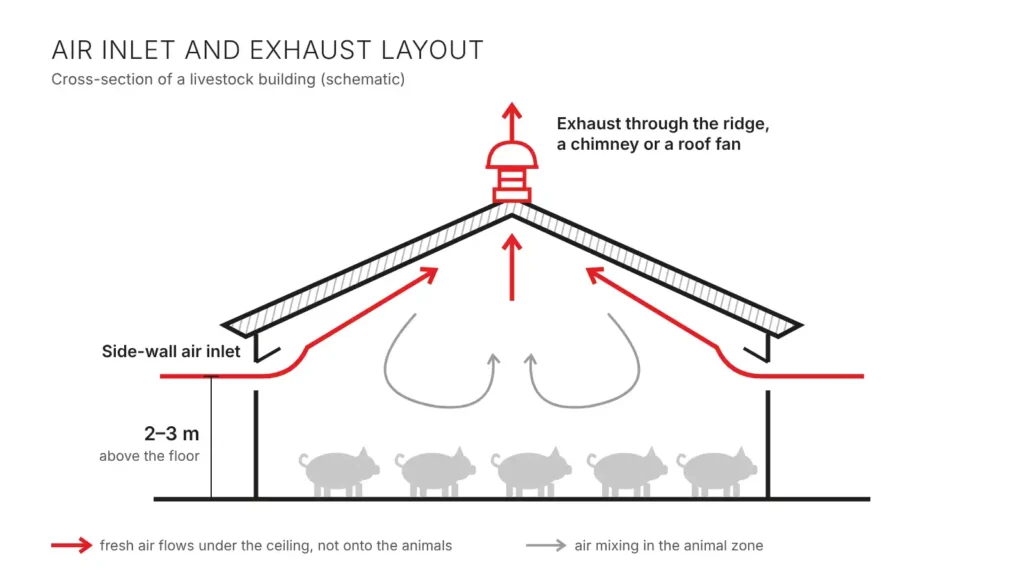
Air inlets are installed on the side walls 2–3 m above the floor, and the exhaust goes through the ridge, chimneys or wall fans. Fresh air must not blow directly onto the animals: in winter that means a draught, and for piglets and calves a straight path to illness. In winter, about 0.2 m/s is considered the limit for air velocity at animal level for pigs and poultry.
Does automation pay off?
Yes. Well-chosen automation adjusts ventilation to the season and, above all, to the weather. It keeps the building from cooling down in winter and from overheating in summer. Automatic control based on temperature, humidity and gas concentration reduces energy consumption. An EC motor is more efficient than an AC motor, especially at low speeds, and in the colder part of the year ventilation runs at exactly that low output.
Which Reventon devices suit livestock buildings?
For ventilation in cattle barns, pig houses, poultry houses and other livestock buildings, we offer FR-BS wall-mounted extractor fans with AC, EC or EC-EE motors and STORM PRO EC roof fans. They are complemented by GS gravity shutters and HMI controllers. In winter, FARMER HCF and FARMER OpenAir LPHW unit heaters heat the building. Each device has its own operating conditions, which need checking before installation, ideally with our technical department.
| Device | Purpose | Data sheet parameters |
| FR-BS wall-mounted extractor fan (AC, EC, EC-EE) | air extraction through the wall | 780–1,550 m³/h (AC), 1,730–23,850 m³/h (EC), 1,710–21,000 m³/h (EC-EE); IP54 |
| STORM PRO EC roof fan | air extraction through the roof | 880–13,800 m³/h; EC motor 70–3,000 W; composite housing; IP44 or IP54 |
| GS gravity shutter | closes the outlet when the fan is off | diameters 300–1,000 mm; up to +50°C |
| HMI EC BMS programmable controller | temperature-based control of an EC fan or unit heater, BMS via RS-485 (Modbus) | IP20, external IP68 temperature sensor |
| FARMER HCF LPHW unit heater | heating and air mixing in winter | IP54 or IP66; 44.0–49.9 kW at 90/70°C and 0°C air; 4,000–5,000 m³/h |
| FARMER OpenAir LPHW unit heater | heating in very dusty buildings, e.g. poultry houses | IP66; 54.3 kW (OpenAir) and 63.9 kW (OpenAir XL) at 90/70°C and 0°C air; 5,100 and 4,500 m³/h |
The AC version delivers up to 1,550 m³/h, so it suits small rooms. In a large cattle barn, pig house or poultry house, the EC and EC-EE versions provide the capacity you need. Their motors can be steplessly controlled within a certain range, so one type of fan can handle both lower and higher airflows.
FR-BS fans are designed for indoor installation and are controlled by HMI controllers or an HC speed controller. STORM PRO EC roof fans are installed on flat or pitched roofs on a roof base. The GS shutter protects against backdraught, heat loss, rain and larger debris when the fan is not running.
The HMI EC BMS controller has an IP20 housing and is not designed for very dusty rooms or rooms with chemically aggressive vapours. It is therefore installed outside the animal area, e.g. in a plant room, and only the IP68 temperature sensor is run into the building.
FARMER OpenAir and FARMER HCF LPHW unit heaters are suitable for poultry houses. FARMER OpenAir has a hinged frame that makes cleaning the heat exchanger easier and a housing resistant to dust and water jets (IP66). In farm buildings without animals, such as warehouses, standard HC-3S LPHW unit heaters do the job. Our customers already use them in their warehouses in Norway, Greece and Kosovo.
Where do FARMER unit heaters work?
Our FARMER unit heaters work in pig and poultry houses in several countries. The best example is a pig house in Canada, where FARMER HCF unit heaters heat a long building with finishing pigs on bedding and in pens with feeders. The units hang below the ceiling above the pens, and fresh air enters through inlets in the side walls.
In Ukraine, a FARMER OpenAir unit heater was mounted on the structural columns of a building with pig pens, where air is extracted through ventilation openings in the ceiling. In broiler houses, the unit heaters hang on the walls above the litter and heat the air entering through inlets in the side walls.
Looking for unit heaters for a poultry house, pig house or cattle barn? See the FARMER series.
When won’t such a system work?
Natural ventilation is usually not enough in poultry and pig houses with high stocking densities, because it cannot be controlled in hot, windless weather. Large broiler farms with tunnel ventilation need very high airflows and dedicated tunnel fans, and a few wall fans cannot replace such a system.
In hot weather, ventilation alone also has a limited effect. A review by Schauberger et al. (2020) showed that in pig and poultry houses, cooling the supply air, e.g. with evaporative cooling pads or an earth-air heat exchanger, reduces heat stress more effectively than increasing the airflow.
We do not recommend destratification fans for livestock buildings: according to their data sheet, they are not designed for corrosive or very dusty rooms (above 0.3 g/m³) or for humidity above 90%. According to their data sheet, GS shutters are not designed for very dusty environments or chemically aggressive vapours either. Check their use on the exhaust of a poultry or pig house with our technical department.
Frequently asked questions (FAQ)
Which fans should I choose for a poultry house?
Poultry house fans are sized for summer demand, roughly 4–6 m³/h per kilogram of broiler body weight, with a reserve for the resistance of shutters and inlets. The breed management guide gives the exact values for a flock. An EC motor with stepless control helps, because the same fan can then also handle minimum ventilation in winter. Check the details of the selection for your poultry house with our technical department.
How many fans does a pig house need?
Fans for a pig house are sized for the planned stocking and the summer air requirement. For 500 finishing pigs, that is about 75,000 m³/h, which at free air delivery means, for example, four FR-800-BS EC-EE fans or eight FR-630-BS EC-EE fans. The final number comes from the fan curve for the resistance of the shutters and inlets, because the airflow in the building is lower than in the data sheet.
What ammonia concentration is allowed in pig houses and cattle barns?
Under Polish law, ammonia in pig houses and calf housing must not exceed 20 ppm, CO₂ 3,000 ppm and hydrogen sulphide 5 ppm. For adult cattle, the regulations give no figures and only require levels that are not harmful to the animals, so the same limits are a good benchmark. In other countries, check your national regulations.
What air humidity is acceptable in a livestock building?
Polish regulations give a figure only for broilers kept at more than 33 kg/m²: average humidity over 48 hours must not exceed 70% when it is below 10°C outside. This requirement comes from Directive 2007/43/EC, so it applies across the EU. For other animals, the rules require humidity, temperature and gas concentrations to be kept at levels that are not harmful to the animals (Directive 98/58/EC). High humidity encourages mould, wet bedding, hoof problems and respiratory disease, which is why minimum ventilation in winter is mainly about removing moisture.
Can a cattle barn rely on natural ventilation alone?
In a tall, open loose-housing barn, natural ventilation can be enough for most of the year. In summer, in hot and windless weather, it usually lacks capacity, which is why most barns have a hybrid system with fans.
What is the difference between natural and mechanical ventilation?
Natural (gravity) ventilation exchanges air through differences in temperature and pressure, so it uses no electricity, but its performance changes with the weather. Mechanical ventilation moves air with fans, so it provides a constant air exchange regardless of the weather and can be controlled automatically. Poultry and pig houses with high stocking densities usually need mechanical ventilation, while in tall barns natural ventilation with fans for summer is often enough.
What is a gravity shutter on a fan for?
A gravity shutter opens under the pressure of the air from the fan and closes when the fan stops. This stops cold air flowing back in, keeps rain out and reduces heat loss in winter. In poultry and pig houses, check its use with our technical department, because standard GS shutters are not designed for very dusty environments.
Can an FR-BS fan be installed outdoors?
No. The FR-BS fan is designed for indoor installation. On the outside, the outlet is closed with a gravity shutter; check its selection for a poultry or pig house with our technical department.
Summary
Well-designed ventilation is the cheapest medicine for your herd. Effective livestock building ventilation starts with the number and type of animals. Calculate the summer and winter requirement, check the gas limits that apply to your farm and plan an alarm with back-up ventilation. Then choose the system type and fans with controls that can handle both seasons, and check their airflow at the operating point. Send us the building dimensions and stocking, and we’ll help you choose the equipment.
We cite regulations and research data from the sources listed below; airflow ranges and device parameters come from Reventon technical materials.
Sources
- Regulation of the Polish Minister of Agriculture and Rural Development of 15 February 2010 (Dz.U. 2010 No. 56, item 344): https://isap.sejm.gov.pl/isap.nsf/DocDetails.xsp?id=WDU20100560344
- Regulation of the Polish Minister of Agriculture and Rural Development of 28 June 2010 (Dz.U. 2010 No. 116, item 778): https://isap.sejm.gov.pl/isap.nsf/DocDetails.xsp?id=WDU20101160778
- Council Directive 2007/43/EC laying down minimum rules for the protection of chickens kept for meat production: https://eur-lex.europa.eu/eli/dir/2007/43/oj
- Council Directive 98/58/EC concerning the protection of animals kept for farming purposes: https://eur-lex.europa.eu/eli/dir/1998/58/oj
- Schauberger G. et al. (2020). Efficacy of adaptation measures to alleviate heat stress in confined livestock buildings in temperate climate zones. Biosystems Engineering, 200, 157–175. https://doi.org/10.1016/j.biosystemseng.2020.09.010
- Habimana V. et al. (2023). Genes and models for estimating genetic parameters for heat tolerance in dairy cattle. Frontiers in Genetics, 14, 1127175. https://doi.org/10.3389/fgene.2023.1127175
- Wathes C.M., Demmers T.G.M., Xin H. (2003). Ammonia concentrations and emissions in livestock production facilities: guidelines and limits in the USA and UK. ASAE Meeting Paper No. 034112. http://lib.dr.iastate.edu/abe_eng_conf/123