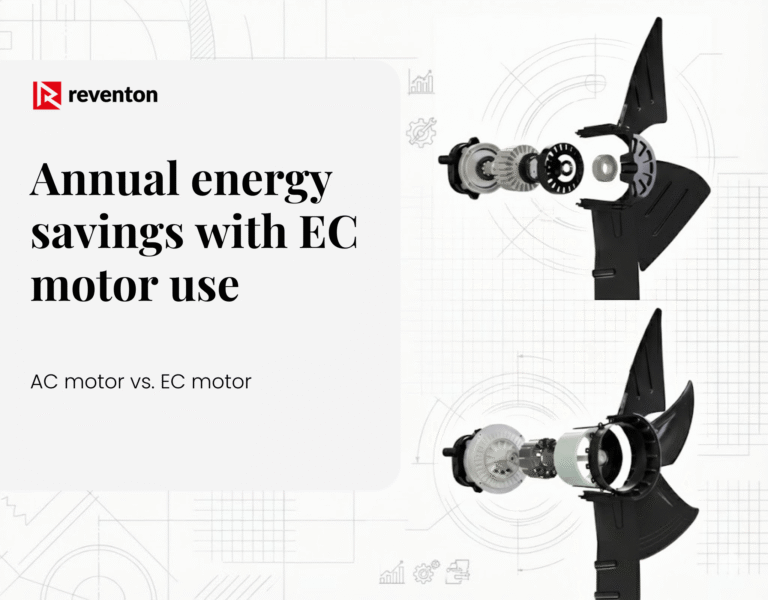
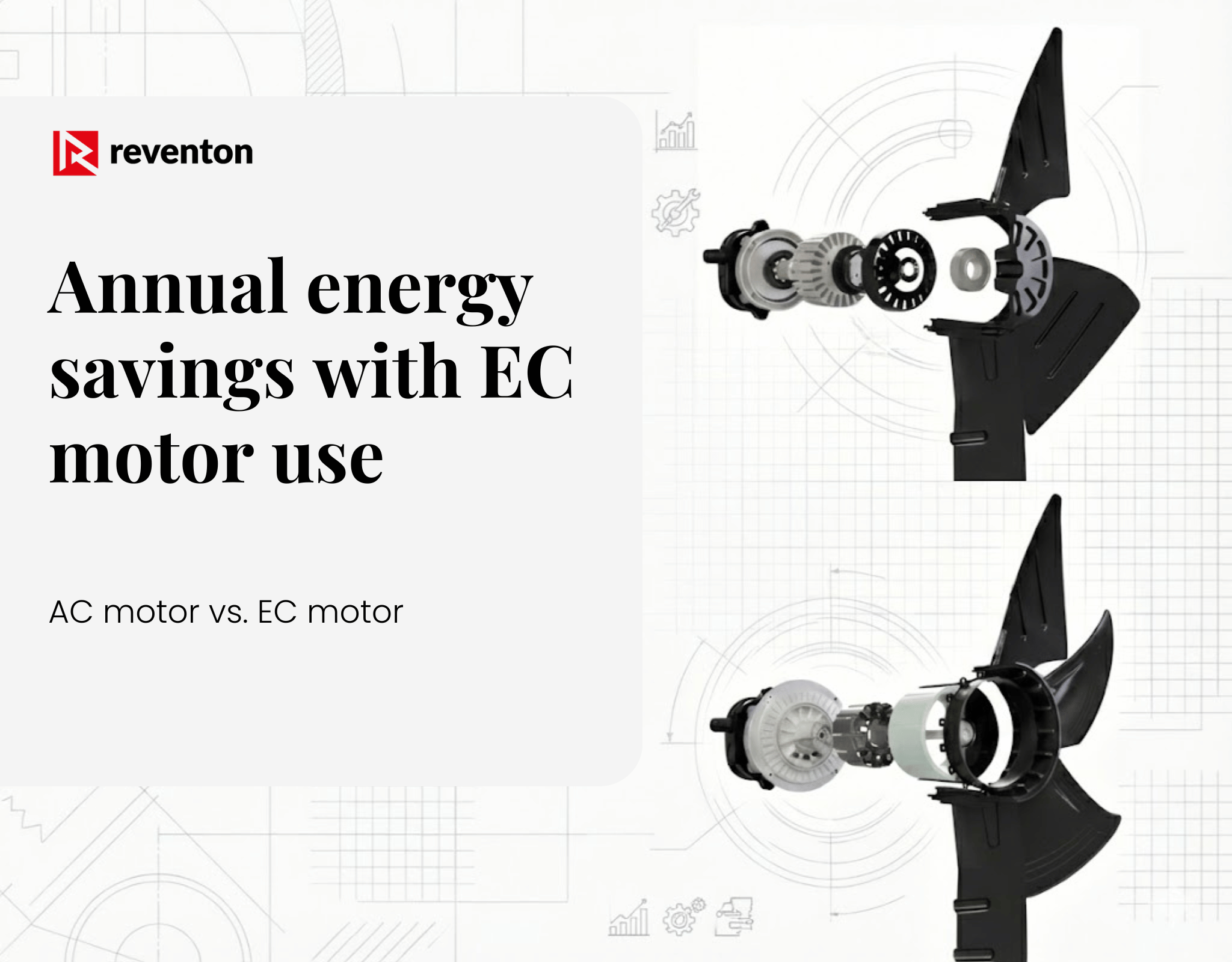
The following case study compares EC and AC fans with a 450 mm impeller diameter used in industrial and commercial premises. The objective is to demonstrate the difference between the fans and to compare the energy consumption of two motors operating at the same output level over the course of a year.
Key information
- Maximum energy efficiency: An EC motor can save up to 59% of electrical energy per year compared with a standard AC motor.
- Precise control: Integrated electronics enable continuous speed regulation across the full 0–100% range.
- High efficiency: The unit generates lower power consumption whilst maintaining the same airflow output as its AC counterpart.
- Longer service life: The brushless design of the EC motor eliminates wearing components, ensuring longer and trouble-free operation.
- Cost reduction: EC technology guarantees a real reduction in electricity bills regardless of the system load.
How do AC and EC motors differ in FR fans?
Fan motors differ primarily in their design and the speed control functions available.
Standard AC motors
Standard AC induction motors are widely used in the HVAC sector, where consistent airflow is important. Speed control is limited (for single-speed fans, it can only be achieved via voltage regulators).
Modern EC motors
EC motors are used in applications where flexible fan operation is required and electricity consumption is to be reduced – EC motors consume less energy at lower fan speeds, as demonstrated in the study below.

In addition, EC motors incorporate precise integrated control electronics – they are brushless, which gives them a significantly longer service life, and speed control is provided by a 0–100% speed regulator.
EC motor vs AC motor comparison
| Motor type | Standard AC motor | EC motor |
| Energy efficiency | Standard | Higher – energy savings of up to 20–60% with appropriate power modulation |
| Speed control | Limited (stepped), requires a voltage regulator | Continuous speed regulation (0–100%) |
| Power consumption | Constant | Lower for the same airflow output |
Case study: difference in EC vs. AC fan operation
To demonstrate the difference in unit operation effectively, two fan operating scenarios are used. The first concerns the same output at higher resistance values given in [Pa], and the second concerns the same output at lower resistance values given in [Pa].
A) At the highest speed, for a shared airflow output of 3,000 [m³/h] and assuming a resistance of 150 [Pa].
EC MOTOR: power consumption -> 423 [W] -> At 10 V signal
AC MOTOR: power consumption -> 495 [W] -> At HIGH speed
Assuming the fans operate for 4 hours per day and the energy cost is 1.1 PLN per kWh.
| EC motor | AC motor | |
| Purchase cost | — | — |
| Annual consumption | 618 [kWh] | 723 [kWh] |
| Annual energy cost | 680 [PLN] | 795 [PLN] |
For the above parameters, the cost difference shows that the EC motor consumed approximately 15% less energy over the course of a year.
B) At the lowest speed, for a shared airflow output of 4,000 [m³/h] and assuming a resistance of 15 [Pa]
EC MOTOR: power consumption -> 118 [W] -> At 6 V signal
AC MOTOR: power consumption -> 286 [W] -> At LOW speed
Assuming the fans operate for 4 hours per day and the energy cost is 1.1 PLN per kWh.
| EC motor | AC motor | |
| Purchase cost | — | — |
| Annual consumption | 172.3 [kWh] | 418 [kWh] |
| Annual energy cost | 190 [PLN] | 460 [PLN] |
For the above parameters, the cost difference shows that the EC motor consumed approximately 59% less energy over the course of a year.
Summary
The above results demonstrate that EC motors, with appropriate speed optimisation, can reduce annual energy consumption, which is significant when multiple units operate simultaneously. This result may vary at different air resistance values. Under the above assumptions, the EC motor consumed approximately 59% less energy per year at the lowest speed and 15% less energy at the highest speed.