A unit heater and heat pump combination is something owners of industrial buildings ask about more and more often when they look at their gas bills. The answer is yes: LPHW unit heaters can work with a heat pump, but they have to be selected for the lower water temperature the heat pump supplies.
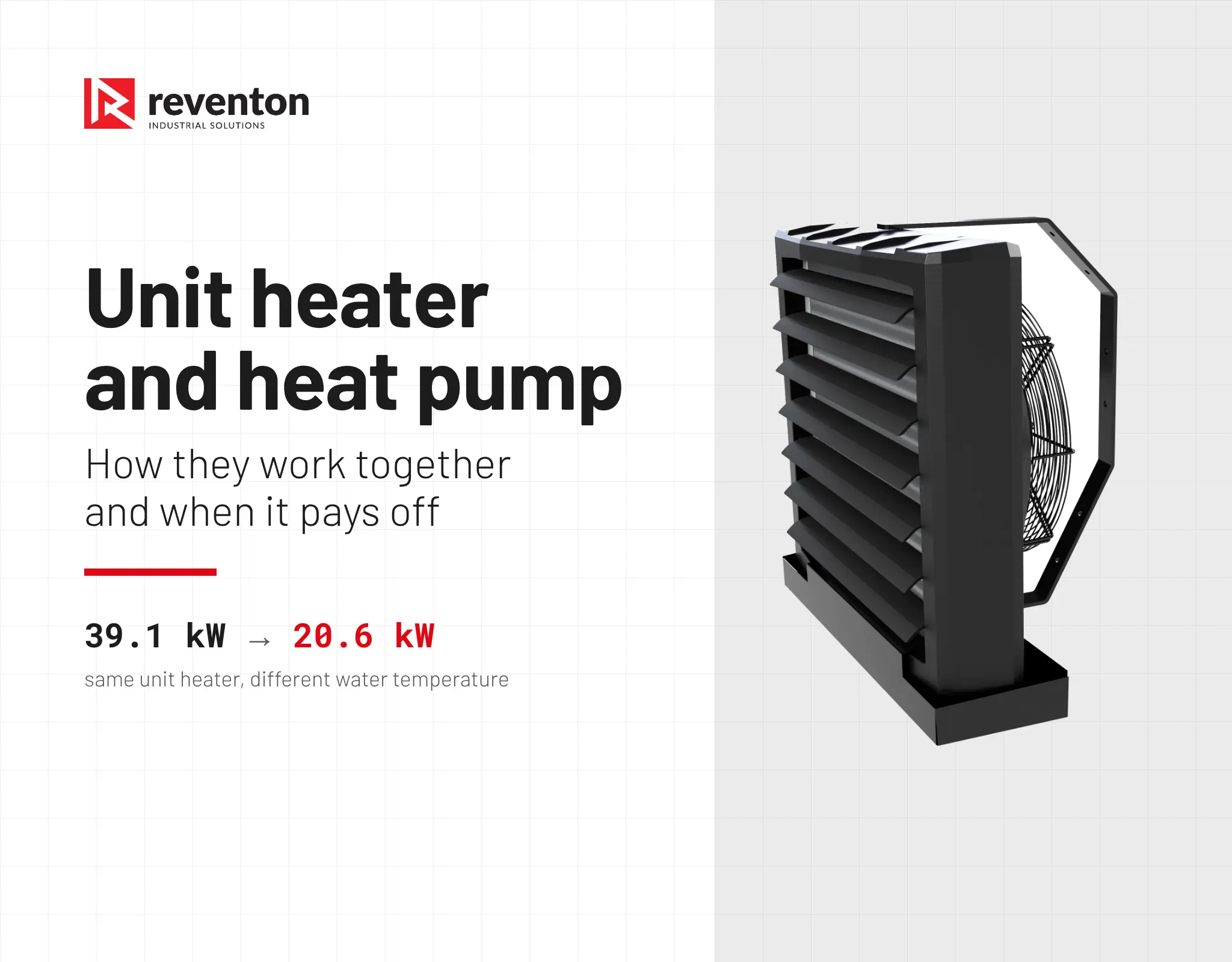
The same model that heats a building without any trouble on 80/60°C water from a boiler will deliver roughly half its output on 50/40°C water. If nobody accounts for this at the design stage, you end up with an underheated building and have to buy extra units after the first winter. Using data from our own products, we will show how much output a unit heater loses, how many units you need and in which buildings the combination pays off.
Key information
- An LPHW unit heater takes heat from water (or another heating medium) and transfers it to the air in the room. That is why it can work with a heat pump just as it does with a boiler, and it uses electricity only for the fan.
- With 50/40°C water from a heat pump, a unit heater delivers about half the output the same unit achieves with 80/60°C water from a boiler.
- With a heat pump you need more unit heaters, but that does not mean higher annual costs.
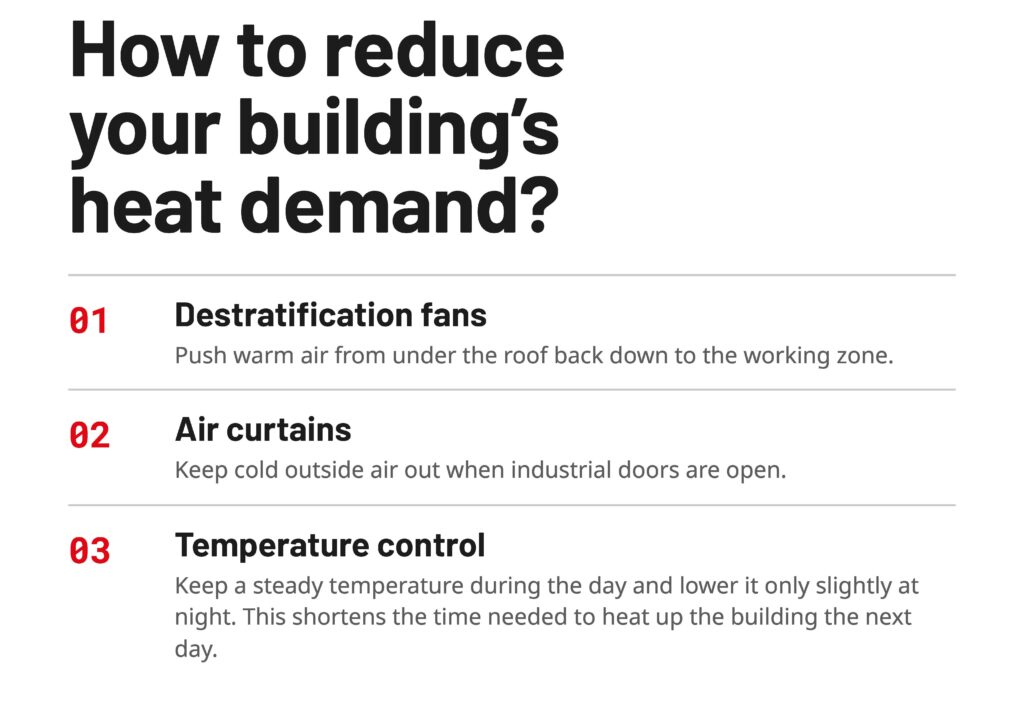
- Popular ways to reduce a building’s heat demand are destratification fans, which push warm air from under the roof down to the working zone, air curtains over industrial doors and steady temperature control.
How does an LPHW unit heater work with a heat pump?
The heat pump is the heat source and the unit heater is the heat emitter. The heat pump heats the water in the system, and the unit heater transfers that heat to the air in the building.
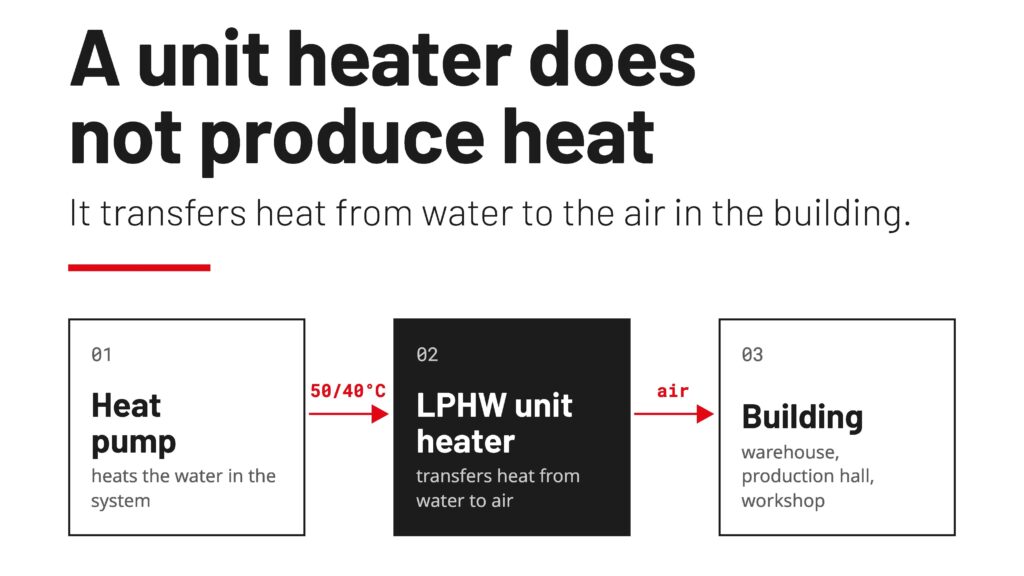
Inside the unit heater there is a heat exchanger, a set of finned tubes carrying hot water, and a fan that blows the building’s air through it. The unit heater itself does not produce heat. Electricity powers only the fan (240 W at top speed on the HC 70-3S). That is why an LPHW unit heater works with almost any heat source, from gas and oil boilers to district heating and low-temperature heat pumps.
A heat pump, on the other hand, uses a refrigerant circuit to take heat from outdoor air, the ground or water, and a compressor compresses the refrigerant, which raises its temperature. If the heat pump has to produce water at a higher temperature, it uses more electricity for every kilowatt-hour of heat. This is the crux of the matter: a heat pump runs most cheaply at a low water temperature, while a unit heater delivers less output at a low water temperature.
How much output does a unit heater lose on a heat pump?
With 50/40°C water, a unit heater delivers roughly half the output it achieves at 80/60°C. At 40/30°C, about a third remains.
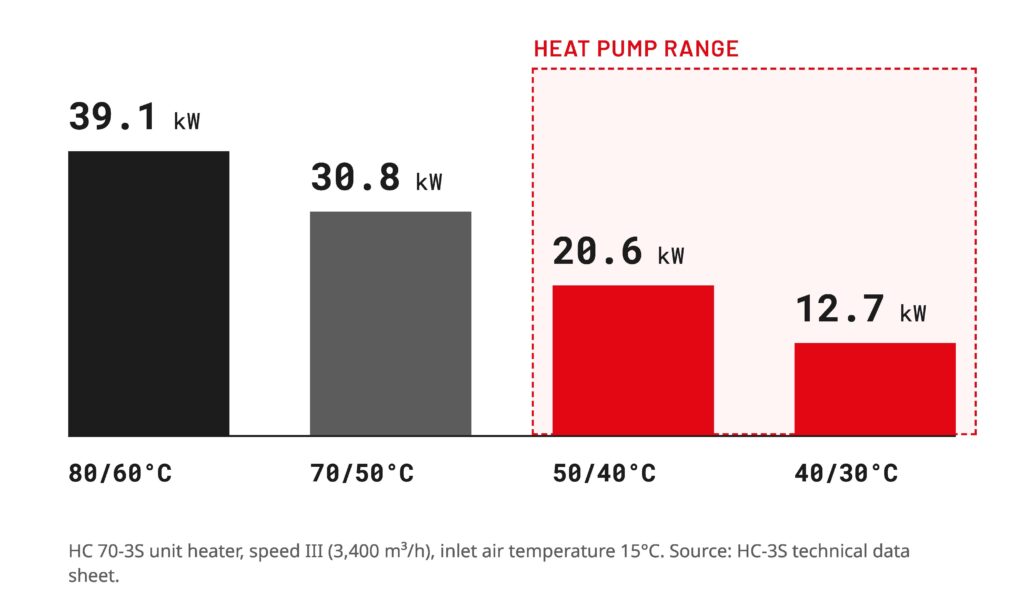
The notation 80/60°C means the flow and return water temperatures. A unit heater’s output depends on the temperature difference between the water and the air passing through it. When the building is at 15°C, water at 80°C has plenty of margin. At 50°C that difference is half as large, and the output drops by roughly the same proportion.
This is how it looks in the technical data sheets for our unit heaters, at maximum airflow and an inlet air temperature of 15°C:
| Model | 80/60°C | 70/50°C | 50/40°C | 40/30°C | Supply air at 40/30°C |
| HC 45-3S | 27.0 kW | 21.1 kW | 13.9 kW | 8.5 kW | 25.1°C |
| HC 70-3S | 39.1 kW | 30.8 kW | 20.6 kW | 12.7 kW | 26.2°C |
| HC 80-3S | 44.7 kW | 35.0 kW | 23.1 kW | 14.1 kW | 25.0°C |
| HC 50-EC | 31.2 kW | 24.4 kW | 16.6 kW | 10.1 kW | 21.3°C |
| HC 70-EC | 42.7 kW | 33.6 kW | 22.6 kW | 13.9 kW | 25.4°C |
| FARMER HCF IP54-EC | 31.2 kW | 24.4 kW | 16.6 kW | 10.1 kW | 21.3°C |
Do not forget the cooler supply air. With 40/30°C water, air leaves the unit heater at 21–26°C, compared with over 49°C for the HC 70-3S at 80/60°C. The building still warms up, but people working close to the unit heater may feel the airstream as cool. Keep this in mind when positioning the units.
When comparing offers, remember that nominal output in technical documentation is usually given for 90/70°C water and 0°C air. It is a good reference point for comparing models, but with a heat pump you need to look at the tables for lower temperatures.
How many unit heaters do you need and what does it mean for your budget?
With a heat pump you need more unit heaters, or larger models, than with a boiler. The higher upfront cost is then recovered through cheaper heat.
Take a building with an example heat demand of 75 kW. With HC 70-3S unit heaters and 15°C air, the result is:
- 80/60°C water from a boiler: 2 unit heaters (78.2 kW),
- 50/40°C water from a heat pump: 4 unit heaters (82.4 kW),
- 40/30°C water from a heat pump: 6 unit heaters (76.2 kW).
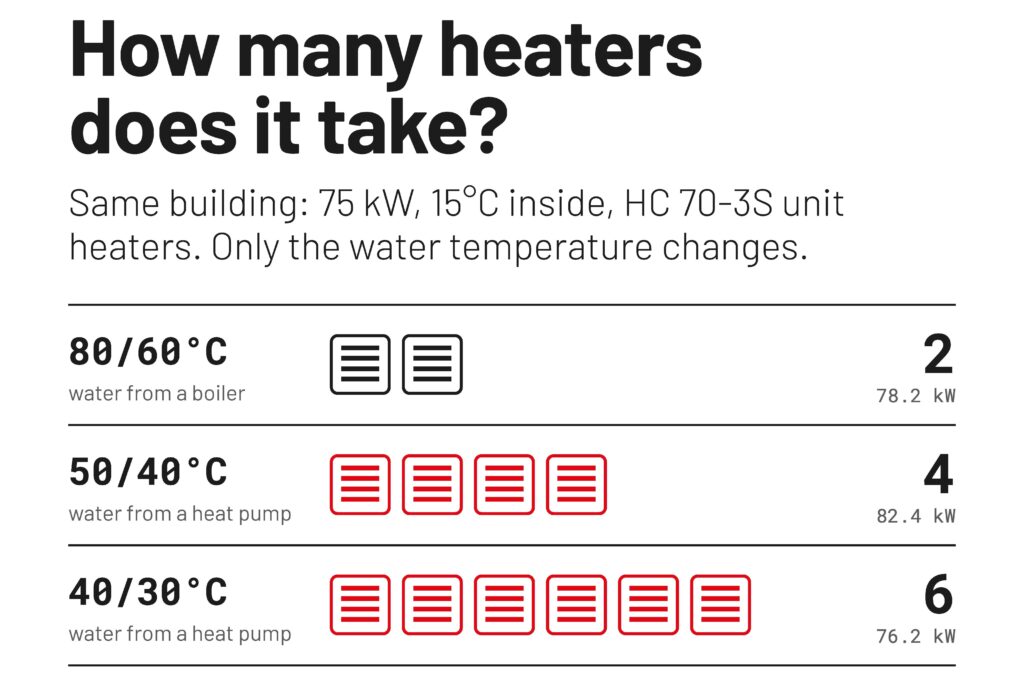
More unit heaters do not, however, mean higher annual costs. Heat pump efficiency is described by the COP (coefficient of performance), which shows how many kilowatt-hours of heat the heat pump delivers relative to the electricity it uses. The cooler the water the heat pump produces, the higher its COP. A larger number of unit heaters lets you heat the building with 40/30°C or 50/40°C water, so the heat pump uses less electricity for the same amount of heat. Raising the water temperature to get by with fewer units usually leads to higher bills every season.
When does a unit heater and heat pump combination pay off, and when does it not?
It works best in an insulated building kept at a steady temperature around the clock. It works less well where the building loses a lot of heat and has to be warmed up quickly.
An ideal example is a warehouse or production hall with insulated walls and roof, where the doors are not left open for half a shift (ideally with a solar PV system on the roof). The heat pump then runs for long, even periods at a low water temperature.
It is different in a tall building with a thin envelope, where doors are opened frequently, or where the building is heated only during working hours and has to be warmed up quickly in the morning. Heat demand is then high, while unit heaters running on low-temperature water have less output to offer.
How can you reduce a building’s heat demand?
Warm air rises and collects under the roof. In tall buildings it is often noticeably warmer under the ceiling than at floor level, and heat is frequently lost through the roof. That is why destratification fans, which push the air back down, are a worthwhile investment. Heat is also lost through doors opened during the day. Here we recommend air curtains, which block cold outside air from coming in.
Control with a heat pump needs a different approach than with a boiler. Large night-time temperature setbacks often do not pay off, because in the morning unit heaters running on cooler water take a long time to bring the temperature back up. Steady operation with only a slight setback works better.
If you are not sure what the most environmentally friendly option would be, or what will make the biggest difference in your building, book a free technical consultation. We will review the building and select unit heaters to match the water temperature from your heat pump.
Frequently asked questions (FAQ)
Can I connect my existing unit heaters to a new heat pump?
Yes, it is technically possible, but first check how much output they will deliver at the new water temperature. Unit heaters selected for an 80/60°C or 90/70°C boiler will usually not provide enough output with a heat pump. In that case, additional units are installed or the boiler is kept to run during frosts.
Do I need a buffer tank with a heat pump and unit heaters?
Often, yes. A buffer tank stabilises heat pump operation and reduces frequent compressor starts, which is especially useful when several unit heaters are controlled separately. The final decision is based on the heat pump manufacturer’s guidelines and the system design for the building in question.
Can a unit heater cool the building in summer with a reversible heat pump?
Yes. Our HC-3S, HC-EC and FARMER HCF unit heaters can work with chilled water; for example, the HC 70-3S delivers 18.0 kW of cooling capacity with 6/12°C water and 28°C air. One system then provides space heating in winter and cooling in summer. During cooling, water condenses on the heat exchanger, so a drip tray with a drain to the sewer is required, and a unit heater with a drip tray can only be wall-mounted, perfectly level.
Can an air-to-water heat pump cope with frost?
Yes, provided it is sized for the design outdoor temperature in your climate zone. In severe frost, the output of the outdoor unit and the heat pump’s COP both drop, just when the building needs the most heat. That is why heat pumps in buildings with high heat losses are often combined with a peak-load boiler.
Are LPHW unit heaters suitable for a tall warehouse?
Yes. LPHW unit heaters are a popular choice for warehouses and also work very well under high ceilings, provided they are selected for their air throw. Warm air has to reach the working zone rather than stay under the roof. Our technical data sheets give the maximum horizontal throw, for example 18 m for the HC 70-3S and 24 m for the HC 50-3S. In tall buildings, it is worth adding destratification fans to bring warm air back down.
Summary
An LPHW unit heater supplied by a heat pump will heat your building if you select it for the actual water temperature, not for the nominal output in the catalogue. This usually means choosing more units, but in return you get cheaper heat throughout the season.
Start by calculating your building’s heat demand and finding out at what temperature your heat pump runs most cheaply. We can take care of the rest together: book a free technical consultation and we will help you select unit heaters for your building and heat source.