The operating costs of industrial halls, warehouses, and commercial buildings depend to a large extent on the efficiency of the heating and ventilation systems. For HVAC designers and installers, the choice of the appropriate drive becomes the key dilemma when selecting equipment such as unit heaters and fans.
The differences between conventional AC motors and modern EC motors are fundamental and have a direct bearing on lower energy consumption and the operating parameters of the entire system (under defined conditions).
In this article we will examine in detail the construction and control methods of both motor types, and present hard data from our case study that shows when the investment pays for itself quickly.
Key information:
- The choice between AC and EC motors is primarily a decision concerning operating costs and the precision of system control.
- EC motors consume up to 60% less electricity at partial load compared with standard AC motors.
- EC technology enables continuous speed regulation (e.g. via a 0–10 V signal), whereas AC motors typically rely on less efficient stepped control.
- Devices with AC motors are less expensive to purchase, but EC technology guarantees a fast return on investment through significantly lower electricity bills.
- The absence of wearing brushes in electronically commutated drives translates directly into quieter, longer-lasting, and virtually maintenance-free operation.
What are standard AC motors and how do they work?

Motors powered by alternating current (AC) are most commonly induction (asynchronous) machines, in which the electrical current from the supply network generates a rotating magnetic field in the stator. This magnetic field in turn induces a voltage in the rotor, setting it in motion.
Depending on the supply from the network, the following types are distinguished in ventilation applications:
- Single-phase motors (230 V supply) – used in lower-power equipment.
- Three-phase motors (400 V supply) – designed for operation under higher load, generating high torque.
Construction and operating principle of AC motors
The main components are the stator and rotor. The classic design is based on simplicity.
The stator windings generate the magnetic field. In older and more specific industrial applications, wound-rotor motors or solutions based on commutator motors may also be encountered; however, compact induction motors dominate in modern unit heaters and fans.
Advantages and disadvantages of AC motors
The advantages of AC motors include their simple and proven construction, low initial cost, and reliability when operating at constant speed.
Standard AC motors do, however, have significant limitations. Speed control is stepped (e.g. via HC speed controllers or HMI programmable controllers). When these motors operate at lower speeds through voltage reduction, their efficiency drops drastically.
Modern EC motors – direct current motor

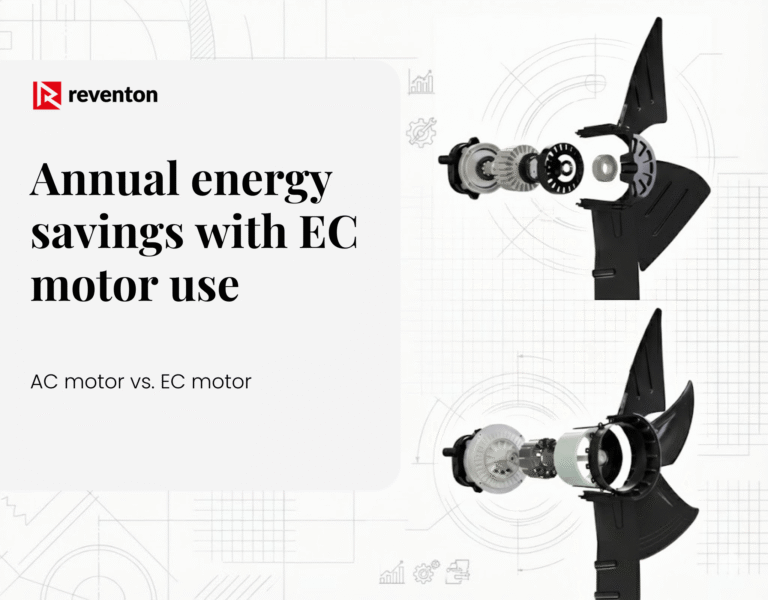
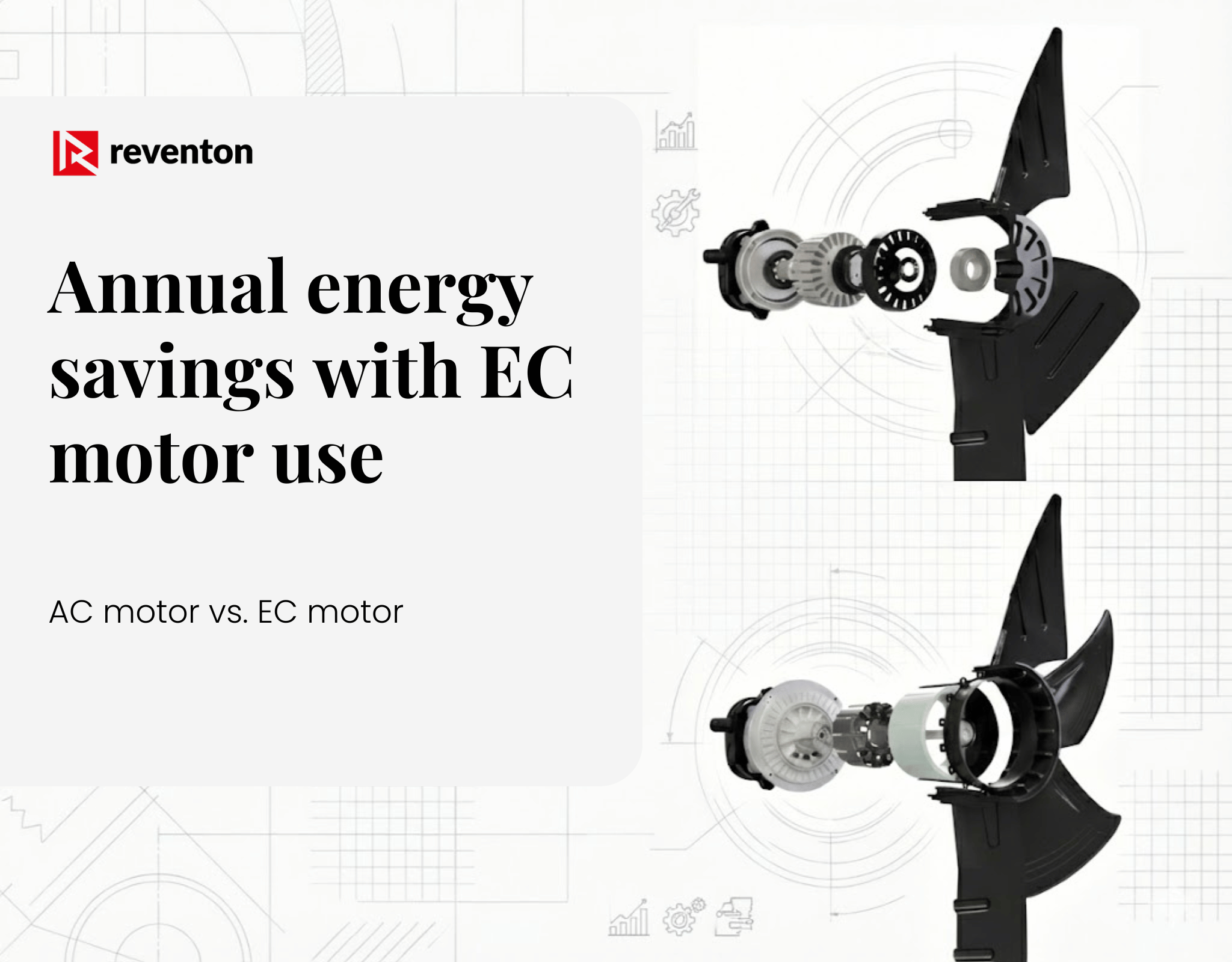
An EC (Electronically Commutated) motor is in reality a brushless direct current motor (BLDC) with integrated control electronics. Although the device is connected to a standard alternating current (AC) supply, the built-in rectifier converts the supply voltage to direct current.
Construction and operating principle of EC motors
- No brushes or mechanical commutator: The traditional mechanical commutator is replaced by an electronic circuit. The absence of brushes eliminates friction and arcing, resulting in a significantly longer motor service life and virtually maintenance-free operation (no need for brush replacement or frequent servicing).
- Permanent magnets in the rotor: Rather than inducing a field in the rotor, EC motors use powerful permanent magnets mounted on the rotor. This means no energy is lost in magnetising the rotor (as is the case with AC motors), which dramatically improves the overall efficiency of the machine.
- Integrated electronics: The electronic circuit precisely monitors the position of the rotor and applies voltage to the appropriate stator windings at exactly the right moment. This enables precise adjustment of rotor speed to match the current demand of the installation.
Advantages and disadvantages of EC motors
The advantages of EC motors include their unrivalled efficiency (particularly at lower speeds), quiet and maintenance-free operation due to the absence of brushes, and the capability for smooth, precise control. The advanced technology does, however, come with a higher initial investment cost, and the on-board integrated electronics may be more susceptible to potential voltage surges than simple, mechanical AC designs.
AC motor vs EC motor – the key technological differences
A comparison of the two technologies reveals why the industry is moving away from simple solutions in favour of electronically commutated technology. Replacing equipment with older AC motors with modern equivalents is a guarantee of optimised performance parameters.
| Feature | Standard AC motor | EC motor |
| Energy efficiency | Standard | Higher – energy savings of up to 20–60% with appropriate power modulation |
| Speed control | Limited (stepped), requires a voltage regulator | Smooth speed regulation across the full 0–100% range (e.g. 0–10 V signal) |
| Power consumption | Constant or marginally lower when speed is reduced, | Lower power consumption for the same airflow output |
| Construction and wear | No integrated electronics; wearing brushes in commutator motors | Brushless design, on-board electronics, reduced winding heat generation |
| Noise level | Often higher (humming during voltage-based regulation) | Quieter operation, particularly at lower motor speeds |
Control and energy efficiency – EC motor vs AC motor
The fundamental difference is apparent in the control methods and the maintenance of efficiency at lower speeds.
In conventional AC motors, speed control is typically carried out in a stepped manner (e.g. 3-speed), using voltage regulators. This method of reducing speed causes motor efficiency to drop drastically, with a proportion of the consumed energy irreversibly lost as heat.
EC motors, by contrast, resolve this problem through their integrated control electronics. Installers can use a simple analogue 0–10 V signal, enabling smooth speed regulation from 0 to 100%. This allows extremely precise adjustment of the unit heater output to the current conditions in the hall, whilst maintaining the maximum energy efficiency of the system.
Reventon case study: Real savings from the use of EC fans
To illustrate the real financial savings resulting from a change of technology, Reventon engineers carried out a comparative analysis. We examined fans with a 450 mm impeller diameter, used in industrial and commercial buildings. The objective was to measure the current consumption of motors operating at the same volumetric airflow output, but driven by AC and EC electric motors respectively.
Scenario A: Operation at high ventilation system resistance
Airflow: 3,000 m³/h, Resistance: 150 Pa.
- EC motor (controlled at 10 V signal): Power consumption: 423 W
- AC motor (on HIGH speed): Power consumption: 495 W
Assumed operation of 4 hours per day and an energy cost of 1.1 PLN/kWh.
- Annual energy consumption, AC motor: 723 kWh (795 PLN)
- Annual energy consumption, EC motor: 618 kWh (680 PLN)
- Result: Energy saving of approx. 15% at the highest shared output level.
Scenario B: Operation at lower resistance (typical partial-load conditions)
Airflow: 4,000 m³/h, Resistance: 15 Pa.
- EC motor (controlled at 6 V signal): Power consumption: 118 W
- AC motor (on LOW speed): Power consumption: 286 W
Using the same cost assumptions:
- Annual energy consumption, AC motor: 418 kWh (460 PLN)
- Annual energy consumption, EC motor: 172.3 kWh (190 PLN)
- Result: At partial system load, the EC motor delivers a remarkable 59% energy saving. This means the higher initial investment pays for itself extremely quickly.
When to use fans with AC motors, and when to choose EC?
The use of fans with conventional AC motors makes sense when the device operates on an on/off basis at full power and the investment budget is severely constrained. They are less expensive to purchase, though their operating costs are higher.
EC technology, on the other hand, is the mandatory solution in modern HVAC projects, particularly where building energy certification is a priority (e.g. BREEAM, LEED). EC motors are selected when:
- maintaining consistent air parameters under variable load is required (continuous regulation),
- lower energy consumption from the grid is the priority,
- extending the trouble-free service life of equipment is desired (longer lifespan due to the absence of brushes),
EC motors vs AC motors – frequently asked questions
Why are EC electric motors more expensive to purchase than AC motors?
They are more expensive because they feature more efficient mechanical components (permanent magnets on the rotor, high-grade stator and windings). They offer power control from 0 to 10 V. However, this price difference is an investment that pays for itself quickly through significantly lower electricity consumption over the course of a year.
Do I need a frequency inverter to control an EC motor?
No. A simple 0–10 V potentiometer is sufficient for continuous speed regulation.
What do I gain from the absence of brushes in an EC motor compared with commutator motors?
Commutator electric motors use brushes to reverse the direction of current, and these brushes are subject to mechanical wear over time. The absence of brushes in an EC motor eliminates this problem, ensuring reliability, longer service life, and quieter operation, as it relies solely on electronic commutation.
AC motors vs EC motors – summary
The choice between AC motors and EC technology is a trade-off between a lower purchase cost and annual energy savings under specific operating conditions.
As demonstrated in our equipment parameter study, the use of EC fans can reduce electricity consumption from 15% at full load to nearly 60% at lower operating resistance.
Would you like to optimise the heating and ventilation costs in your hall?
Selecting the appropriate unit heaters with energy-efficient EC motors requires technical expertise. Contact our technical adviser – we will analyse the requirements of your facility and select equipment tailored to your needs.