Many investors and installers, on seeing a unit heater with a polymer casing for the first time, ask the same question: “Will it hold up in industrial conditions?”. For years we have been accustomed to the idea that steel is synonymous with durability. Galvanised, powder-coated sheet metal appears solid and reliable.
In modern industrial heating, however, a significant shift has occurred. EPP (Expanded Polypropylene), incorrectly confused with expanded polystyrene, is displacing steel from the market. And this is not happening for reasons of cost, but for purely technical ones. In this article we explain why engineers are increasingly choosing EPP and why “plastic” in this context means greater product longevity.
Key information
- EPP is not polystyrene: It is a flexible structural polymer used, among other applications, in automotive bumpers to absorb impact energy.
- Shape memory: An EPP casing does not sustain permanent dents – after an impact it returns to its original form.
- Chemical shield: The material is completely resistant to corrosion, ammonia, and moisture, making it ideal for agricultural and industrial applications.
- Acoustics: An EPP casing dampens vibrations (resulting in quieter operation).
- Benefit for the installer: The unit is up to 30% lighter than its steel equivalent.
What is EPP and why is confusing it with polystyrene a mistake?

Let us start with a definition. EPP is expanded polypropylene. Unlike polystyrene (EPS), which is brittle and fragile, EPP is characterised by high mechanical strength whilst retaining low density.
The best evidence of EPP’s durability is its use in the automotive industry – it is used to manufacture car bumpers and impact-absorbing components. If this material can protect a driver during a collision, it will have no difficulty protecting a heat exchanger in a warehouse.
EPP casing vs steel – how do they behave under mechanical impact?
Every workshop unit heater is exposed to various types of damage, such as being struck by a ladder, a pipe, or accidentally by other equipment.
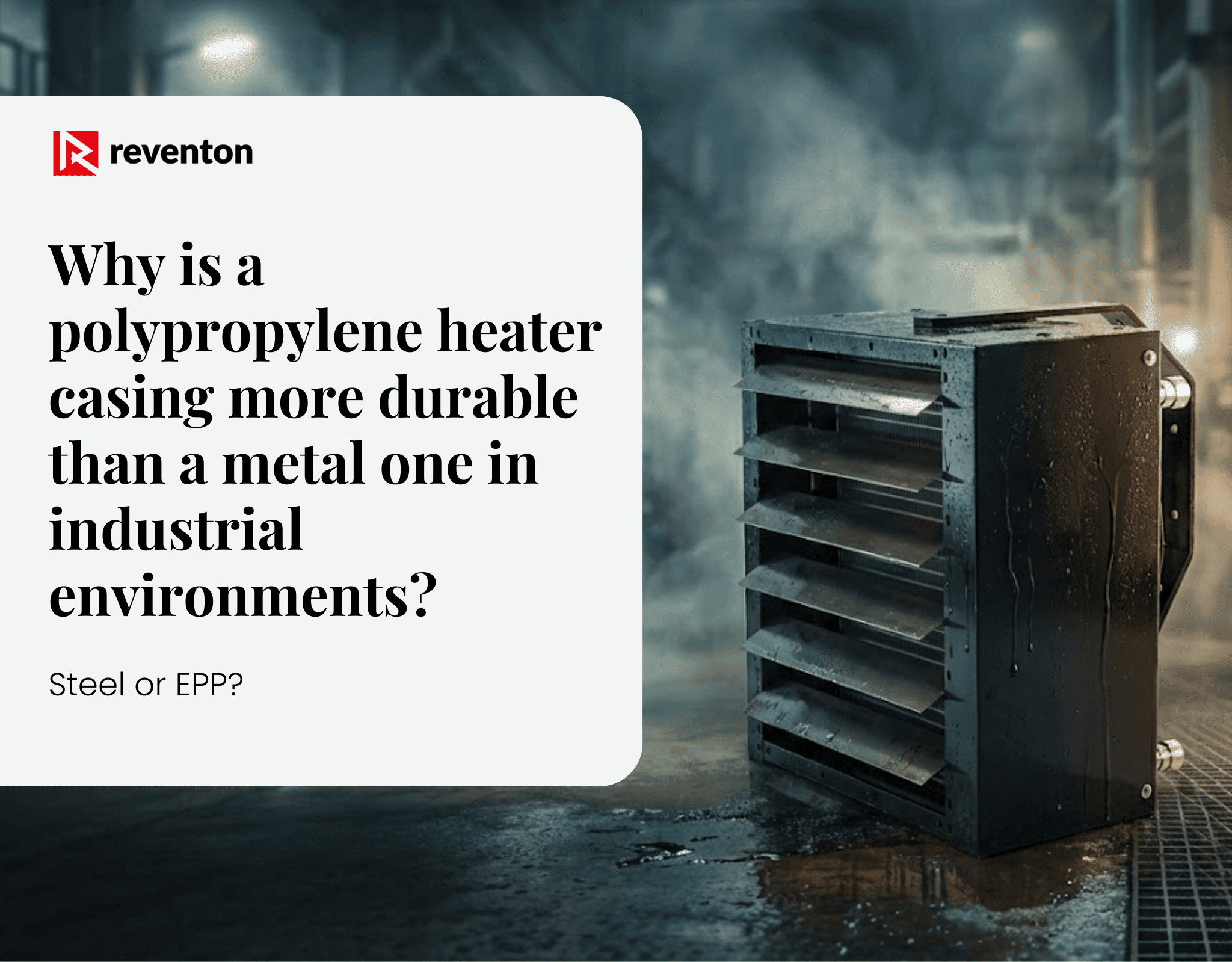
A steel casing has a yield point. After an impact, permanent deformation of the sheet metal occurs. What is more, the paint coating fractures at the point of impact (even with powder coating). This creates the risk of electrochemical corrosion, particularly in humid halls.
An EPP casing has what is known as “shape memory”. It is a visco-elastic material. After an impact, the cellular structure deforms, absorbing the energy, and then returns to its original shape. No dents, no chips, no corrosion.
For the building owner, this means that after 5 years of operation the unit looks exactly as it did on the day of installation, rather than resembling a battered bin.
Why should a workshop unit heater be lightweight and quiet?
EPP’s durability is not its only advantage. Steel is a rigid material that transmits vibrations efficiently. A fan operating within a steel casing frequently causes it to resonate, generating a characteristic “humming” noise that fatigues workers.
EPP is by its very nature an acoustic insulator. The EPP structure dampens motor vibrations and the noise of the airflow. As a result, HC series units are noticeably quieter than their sheet metal equivalents with the same performance parameters.
The second consideration is weight. EPP is lightweight, which greatly simplifies installation.
What are the benefits of an EPP casing?
| Parameter | Steel casing (painted) | EPP casing (Reventon HC) |
| Corrosion resistance | Medium (dependent on coating condition and damage) | Complete (the material does not corrode) |
| Response to impact | Permanent denting, prone to scratching | Returns to shape (elasticity) |
| Thermal insulation | None (metal conducts heat) | High (no heat losses through the casing) |
| Unit weight | High (difficult installation) | Low (easy installation) |
| Acoustics | Risk of casing resonance | Vibration damping (quiet operation) |
Benefit for the CONTRACTOR / INSTALLER: You save your back and your time. Given the relatively high weight and dimensions of unit heaters, installation should be carried out by at least two people; however, a unit heater in an EPP casing is up to 30% lighter, which may allow installation without the need to hire a lifting platform. The convenient 360° mounting bracket included in the kit makes installation a matter of a few tens of minutes.
Benefit for the BUILDING OWNER: Buy once, buy well. The unit is resistant to damage and is less expensive compared with its steel equivalent. The lower weight also means reduced risk of loading the roof structure (important when adapting older buildings).
Summary
By choosing a unit heater in an EPP casing, you gain a unit that is lighter, quieter, and above all, completely resistant to corrosion and mechanical damage.
The best confirmation of this material’s quality is the warranty. We offer a lifetime warranty on the EPP casing of our units. This is a clear signal that, as a manufacturer, we are confident in the durability of this solution, even after many years of operation in demanding conditions.
FAQ – Technical questions about EPP
1. Is EPP safe in a welding workshop? Is it flammable?
The EPP used in Reventon unit heaters is a material that does not sustain combustion. Direct contact with an open flame will melt the material, but under standard workshop conditions it is a safe solution.
2. Does a polymer casing not become brittle under UV exposure and over time?
No. EPP is resistant to ageing. Unlike cheap plastics, it does not “chalk” or crack under sunlight.
3. How should such a casing be cleaned? Can a pressure washer be used?
High-pressure washers should not be used directly. That said, EPP is resistant to most chemicals (oils, lubricants, solvents) and water. It can be cleaned with compressed air or a damp cloth. For heavy soiling, the casing is moisture-resistant, so cleaning does not cause corrosion as it would with steel, but requires low-pressure water.
Do you have questions about selecting a unit heater for your building volume? As the technical department, we are here to calculate, not to guess. Send us a floor plan of your space and we will select units that will provide warmth without breaking the budget.