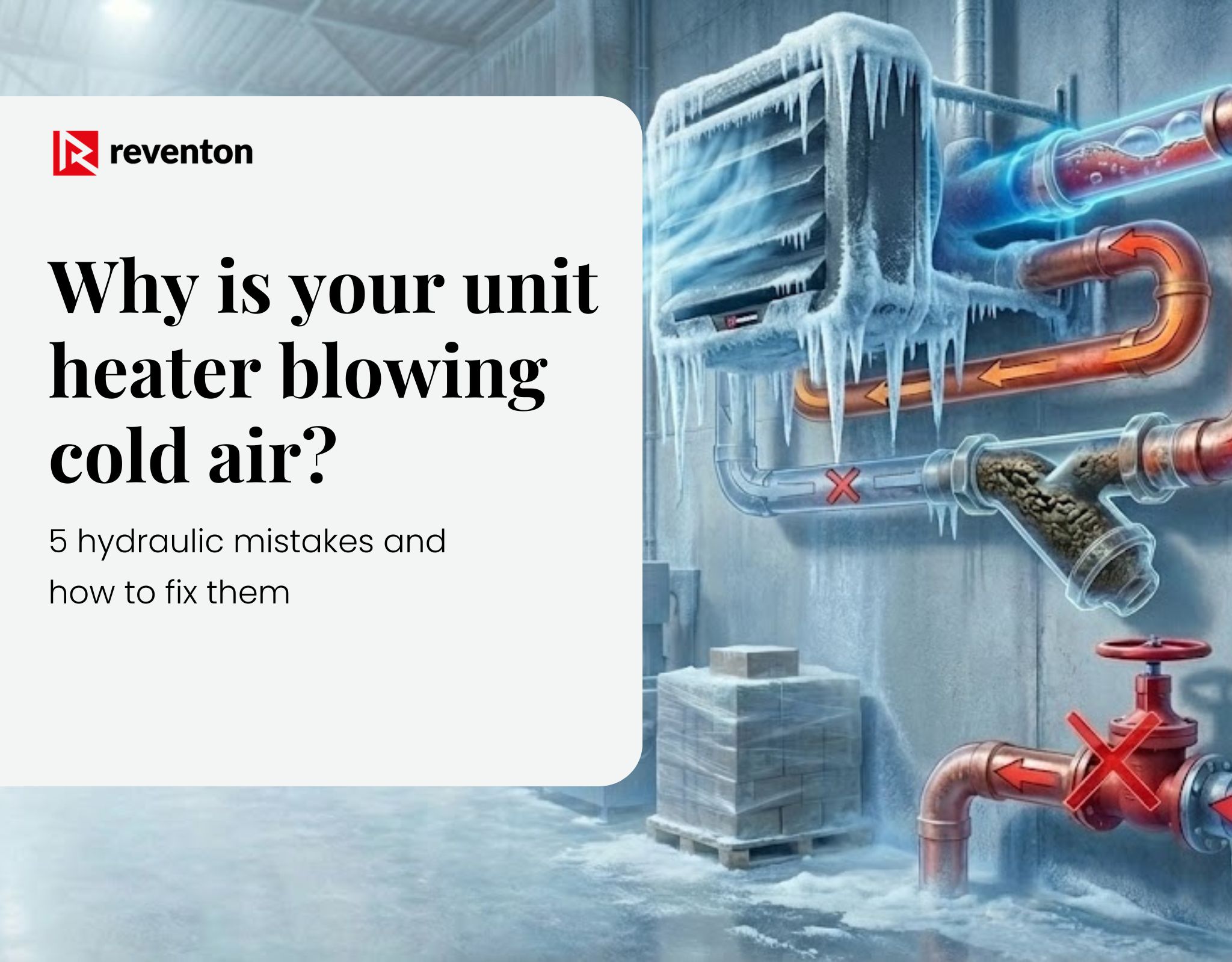
“The new LPHW unit heater is blowing cold!” – that is a sentence I hear every winter. The controller shows heating mode, the fan is running at full speed, and the workers on the shop floor are wearing their jackets. Before you pick up the phone to make a warranty claim, read this. In 90% of cases the unit is functioning correctly, and the problem lies in physics and hydraulics.
Key conclusions
- Air is an insulator: Even a small amount of air in the heat exchanger can reduce heating capacity to zero.
- The “Cold Start” effect: Incorrect positioning of the three-way valve causes cyclical blasts of cold air.
- The Heat Pump trap: Old installation + new heat source (low temperature parameters) = drastic reduction in unit heater output, unless you replace the unit heaters with 2- or 3-row models.
LPHW unit heaters require bleeding – have you done this?
This sounds trivial, but it is the most common installation error. LPHW unit heaters (e.g. HC series) are installed several metres below the ceiling (typically on pillars in the hall) – they are often the highest point of the installation. According to the laws of physics, air bubbles rise.
If you bled only the manifold in the boiler room and not the unit itself at 4–5 metres height, an “air pocket” forms in the heat exchanger. Water will not flow through it.
Symptom: The top of the casing is cold, the bottom is warm (the unit heater is not heating).
Solution for the installer: The installation must be bled using an air vent valve. This should be installed at the highest point of the installation – in this case, at the upper spigot of the unit heater.
Where did you install the three-way valve? (The “Cold Start” problem)
The cold start phenomenon occurs when the flow of hot water through the heat exchanger is cut off by a valve. The hot water, unable to continue flowing, stagnates in the pipe at the valve supplying the heating medium to the LPHW unit heater and cools down. When the valve opens, it is the cooled medium that first enters the unit heater – this is known as the cold start effect.
This phenomenon occurs when two-way valves are installed in the pipework supplying the heating medium to the unit heater.
Solution: Use three-way valves in a mixing arrangement, or install them so that hot water circulates in a loop immediately adjacent to the unit (via a bypass). Hot water must “wait” right next to the unit heater.
Flow or return – have you confused the spigots?

Our LPHW unit heaters with heat exchanger are designed for a counter-flow arrangement. This means that the hottest water should meet the outlet air, and the cooled water should meet the inlet air.
Error: Connecting the flow in place of the return (swapping the spigots).
Effect: Reduction in the log mean temperature difference (LMTD) and a decrease in the unit’s heating capacity of several, and in extreme cases over ten, per cent.
Verification: Check the markings on the unit or in the technical documentation – the spigots are colour-coded with red caps (flow) and blue caps (return).
Is the circulation pump generating adequate pressure?
A frequent scenario in large halls: the designer specified pipe diameters to the minimum, and the contractor used PEX fittings with significant restriction.
Effect: The hydraulic resistance is so great that the pump is unable to provide the nominal water flow rate (e.g. 4,000 l/h for a large unit heater).
Diagnostics: Measure the temperature differential (Delta T) between the flow and return with the fan running. If water enters at 70°C and exits at 30°C (Delta 40K), the flow rate is drastically too low (water “stagnates” in the unit heater and releases all its heat at the beginning). The correct Delta T is typically 10–20K.
Have you replaced the boiler with a heat pump but kept the old industrial LPHW unit heaters?
This is a critical point for building owners refurbishing their premises. An old gas/coal boiler delivered water at 80/60°C. A heat pump delivers a maximum of 45/35°C.
Problem: The output of a unit heater is directly linked to the temperature of the heating medium. A unit heater that had 50 kW on a gas supply may have only 15 kW when connected to a heat pump. That is physics, and it cannot be bypassed.
Symptom: Everything is functioning, there is no air lock, and the unit heater is blowing lukewarm air (approx. 25–28°C), which at the velocity of the airstream is perceived as cold.
Summary
Bear in mind that LPHW unit heaters with heat exchangers are simple in construction – if supplied with an adequate quantity of hot water, they must heat. Before reaching for the phone, check and answer the following questions:
- Has the system been bled at the highest point (directly at the unit heater spigot)?
- Is the three-way valve installed so as to eliminate the “cold start” effect?
- Are the flow and return connected in accordance with the spigot colour coding (counter-flow)?
- Are the pipe diameters not throttling the pump (check Delta T)?
- Have the unit heaters been recalculated for the new, lower temperature parameters of the heat pump?
A correct diagnosis saves time and frustration – for you and for the client freezing on the shop floor.
FAQ – Technical questions
Q: How can I check whether an LPHW unit heater is air-locked without climbing a ladder?
A: Touch the flow pipes at the manifold. If the flow pipe is hot but the return is unnaturally cold (much colder than on other circuits) with the valve open, the lack of flow is most likely caused by an air pocket at the highest point.
Q: Can I fill the installation with glycol to prevent freezing?
A: Not entirely. Our heat exchangers are not designed to operate on glycol alone. The maximum concentration is 50% glycol and 50% water. Bear in mind, however, that glycol has poorer heat transfer properties than water. The heating capacity of a unit heater using a water-glycol mixture can fall by as much as approximately 15%.