A call in the middle of winter: “There’s water dripping from the heat recovery unit – I’ve got a stain on my ceiling!” The building owner’s first thought? Unit failure. Faulty seal. Scrap.
As engineers, however, we know that in 90% of cases the unit is functioning correctly and the fault lies with the installer. Another contributing factor is that the building is “unseasoned”. New buildings need to dry out. Walls frequently contain a great deal of moisture, which subsequently condenses in the heat recovery unit. Water in a heat recovery unit is not a fault – it is proof that heat recovery is working. The only problem is what happens to that water afterwards.
In this article we walk through a quick leak diagnostics guide for the installer, and present designers with a solution that eliminates the condensate problem almost entirely.
Key conclusions:
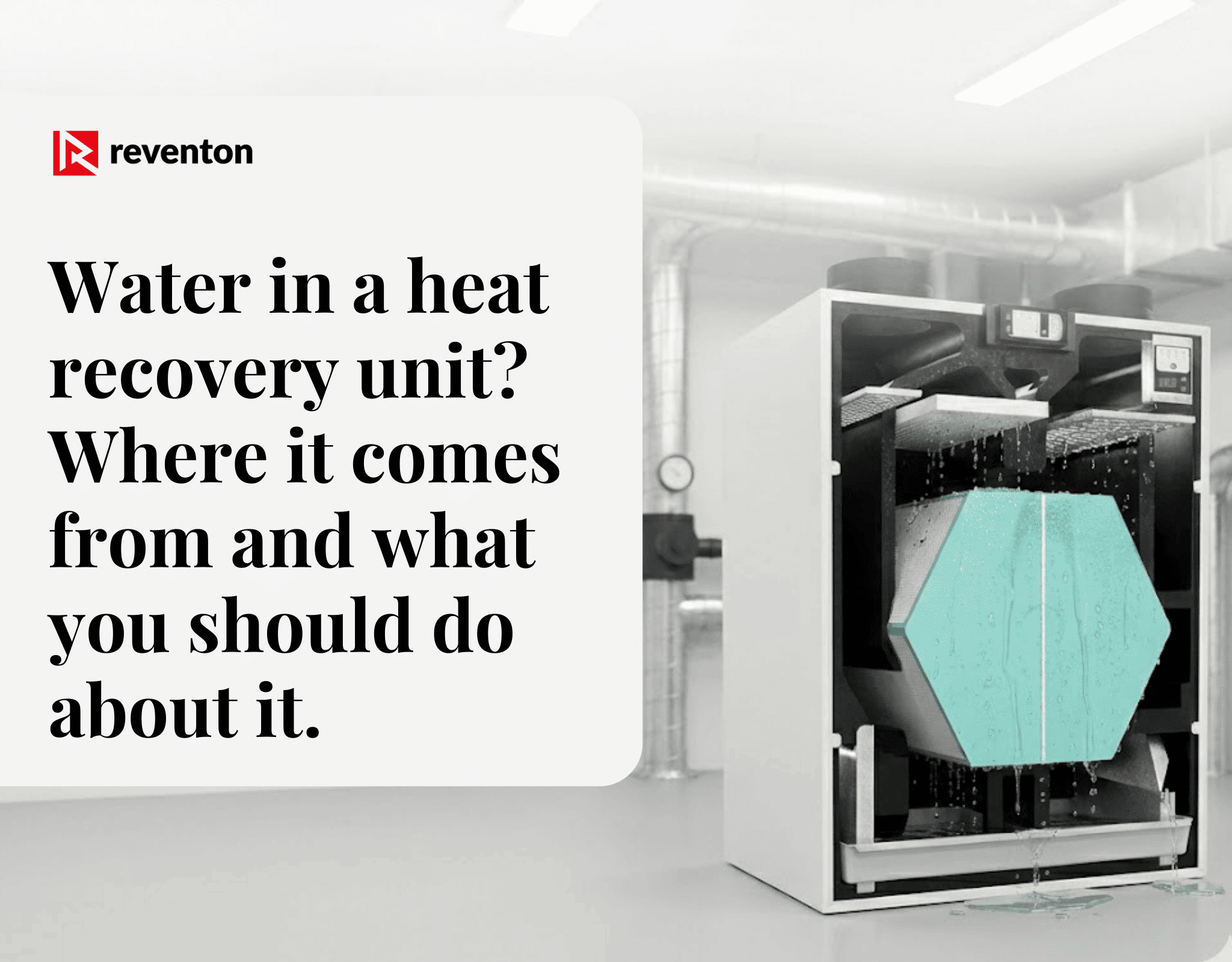
- The heat exchanger cools humid air below the dew point. Several litres of water per day in the condensate tray is normal in winter.
- Even a small break in the insulation of the “cold” ducts (intake/exhaust) will cause condensation to form outside the unit.
- Failure to provide adequate falls in the ductwork is a guaranteed route to water backing up.
- The use of an enthalpy heat exchanger (with moisture recovery) drastically reduces the volume of condensate, eliminates the need for a condensate drainage installation, and improves comfort in winter. Supply air delivered to rooms is pre-humidified.
Where does water come from in a “dry” unit?
Before you start dismantling the casing, understand the mechanism. It is the phenomenon of the Dew Point.
When warm, humid air from a bathroom meets the heat exchanger fins cooled by outdoor air, it rapidly releases energy. Water vapour converts to liquid.
This is exactly the same process you see on a steamed-up mirror after a bath. The difference is that in a heat recovery unit this process continues 24 hours a day, generating buckets of water under extreme conditions.
Why does a heat recovery unit leak?

If water is escaping beyond the condensate tray, check these 3 critical points:
- Have adequate gravity falls been maintained?
Water will not flow uphill. The unit must be levelled with a slight inclination towards the drain outlet, and the condensate drainage installation must maintain a continuous fall.- Common error: The use of flexible hose that deforms over time, creating “bellies” (natural traps) where water collects.
- Has the drain outlet frozen?
If the condensate pipe passes through an uninsulated roof space or exits through the façade, an ice blockage is only a matter of time in frosty conditions.- Solution: Use trace heating cables on external sections, or route the drainage pipe inside the building envelope (to the drain system).
- Trap verification
The negative pressure generated by the fan can “hold” water in the tray if the trap is empty or incorrectly sized. Instead of draining, water backs up until it overflows. Ensure the trap is primed (if a water trap) and clear.
“Sweating pipes” – the silent destroyer of ceilings
I frequently receive reports: “The heat recovery unit is leaking at the joints!” I attend the site and find the unit is dry inside. Where is the water coming from?
It is secondary condensation.
The intake and exhaust ducts carry ice-cold air. If they pass through a warm room (boiler room, laundry room) and are not perfectly insulated, moisture from the surrounding air condenses on their surface.
Requirements for the installer:
- Use rubber or mineral wool insulation of adequate thickness.
- Seal all joints with foam sealing tape – every gap is a thermal bridge and a potential source of condensation.
- If the duct is wet on the outside, the fault lies with the insulation, not the heat recovery unit.
How to forget about condensate drainage altogether
We are treating symptoms when we could remove the cause. The solution that Reventon Group recommends for modern construction is an enthalpy heat exchanger combined with a duct pre-heater.

A conventional heat recovery unit recovers only heat (using a cellulose heat exchanger). An enthalpy heat exchanger, however, also enables moisture recovery (using a polyethylene-graphene heat exchanger).
Why is this cost-effective?
In an enthalpy heat exchanger, the water that accumulates on the walls of a conventional heat exchanger does not freeze. Of course, if the supply air temperature falls below 0°C, an enthalpy heat exchanger can still freeze. This is why we always recommend duct heaters with heat recovery units. This process may occur more slowly than with heat exchangers that have no moisture recovery.
Summary
The appearance of water in a heat recovery unit is most commonly evidence that the heat recovery process is working correctly, not a signal of unit failure. Condensation is a natural physical phenomenon – the cooling of warm, humid, stale air. The key to avoiding ceiling stains is not to replace the unit but to ensure correct installation: proper duct insulation, an unobstructed trap, and adequate gravity falls.
For those seeking maintenance-free solutions and the highest level of comfort, the best approach is to choose an enthalpy heat exchanger. Through moisture recovery, this technology eliminates the problem of excess condensate almost entirely, whilst simultaneously preventing air drying in the home during winter. Bear in mind: water in a heat recovery system is a problem to be solved, not a cause for panic.
FAQ – Technical questions
1. Can I drain the condensate into a rainwater gutter?
This is not recommended. In winter, water in the gutter freezes, blocking the condensate outlet. If you must discharge condensate externally, use a large-diameter pipe, a short run, and absolutely insist on a trace heating cable with a thermostat.
2. Why does the heat recovery unit “spit” water only on the highest speed setting?
This is the result of water droplets being entrained from the condensate tray by the airstream. It frequently occurs when the unit is incorrectly levelled (water stands too close to the fan) or when the trap is blocked and the water level is too high.
3. Can an enthalpy heat exchanger be washed with water?
Yes, the modern enthalpy heat exchangers in Reventon heat recovery units can be washed, but this should be done in accordance with the installation manual (typically with lukewarm water, without strong chemicals and at low pressure).