Every person needs air to function well. Ideally “good” air – air that is fresh, clean, and at the right level of humidity. We often travel to places where, in our estimation, the air meets these criteria, rather than considering what we do on a daily basis in this respect. It is worth examining the air quality in our own home. For many of us, home is a haven where we rest. It is therefore worth ensuring that our home is not only cosy and stylish but also healthy.
How to prevent the air from drying out?
In conventional gravity ventilation systems, air is removed through a flue duct, allowing infiltration of fresh air from outside. In winter conditions, the outdoor air is heated by the heating system before entering the building, which causes a reduction in its relative humidity. Air with low humidity has an adverse effect on room occupants, causing a number of complaints described below.
The use of humidifiers is becoming fashionable as a means of humidifying the air. This is, however, a rather costly solution and, in the case of small humidifiers, not necessarily effective. For this reason, heat recovery with moisture recovery is gaining in importance, as it also aims to maintain an appropriate level of humidity in the supply air.
Why is ventilation essential?
To properly understand the function of a heat recovery unit, one must consider how much dust and other particles are suspended in the air. We try to protect our children, particularly those prone to allergies. We forget, however, that even the most sterile conditions at home cannot replace clean air. This problem affects us particularly during the heating season, when, for fear of heat loss, we neglect the need to ventilate rooms. In this situation, the air in the rooms stagnates, and the dust particles, dead skin cells, and other micro-particles accumulating within it increase in number. The air then becomes heavy and breathing becomes difficult. Inadequate air circulation contributes to headaches and causes a range of other effects that can seriously impair quality of life.
The most common effects of dry and stale air are:
– Headaches – these result from oxygen deprivation arising from both inadequate air humidity and insufficient oxygen content in the air.
– Dry skin – people with sensitive skin are particularly affected, but even those with normally hydrated skin may experience chapped lips, excessively oily hair, or flaking skin.
– Dry mucous membranes – the mucous membrane is the body’s natural defence against viruses and bacteria. Its persistent drying reduces our immunity, making us susceptible to illness. Drying of the mucous membrane is often accompanied by a scratchy throat, as well as itchy and watery eyes.
– Sleep problems – sleep is a time for the body to recover, but under unfavourable conditions our bodies signal that they have not rested. Initially, we may notice a dry mouth or dark circles under the eyes upon waking. We may also sometimes experience a cough during sleep.
How does heat recovery work?
Heat recovery units are devices of steadily growing popularity, both for their properties and due to current building regulations, which in practice make the installation of a heat recovery unit a necessity in new-build projects.
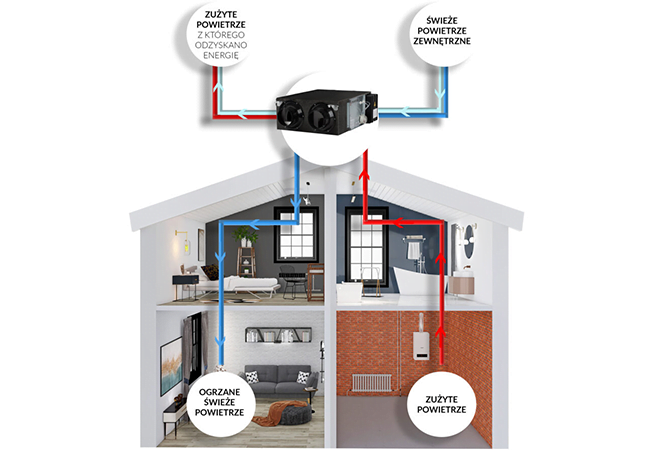
The operating principle of the unit is very simple – in the enthalpy heat exchanger, heat and moisture are exchanged between the supply and exhaust airstreams from the room. The streams do not mix directly, however – heat passes through the walls whilst moisture infiltrates through special pores in the material from which the heat exchanger is constructed. This phenomenon is precisely what is referred to as heat recovery with moisture recovery. The flow of air through the heat exchanger is provided by the fans installed in the unit – one draws air from outside and supplies it to the room, whilst the other extracts air from the room and discharges it outside. A heat recovery unit also frequently incorporates filters that capture contaminants present in the airflow.

How is the unit controlled?
The operation of a heat recovery unit can be controlled in several ways. One of these is a dedicated control panel, which enables, among other things, an operating schedule to be established. Another control option is the use of a Wi-Fi module to control the unit via a smartphone, for example. This solution is particularly appealing to those who enjoy the latest technology. It is worth noting that a heat recovery unit requires little attention from the user – once a schedule has been created, it will serve well for a long period without the need for changes.
What do you know about grants and allowances for this purpose?
If you are seriously considering installing a heat recovery system in your home, you are welcome to apply for grants as well as tax relief under the “Clean Air” programme. The applications you will need to complete are considerably simplified, and the benefits of participating in the programme are tangible. We are talking about co-financing from 30,000 zlotys to as much as 37,000 zlotys. Among the eligible costs of the grant you will find all the activities necessary to commence and carry out the process of installing a heat recovery system – from the design documentation, through the purchase of the unit, to its installation together with the necessary pipework.
More information about grants can be found on the “Clean Air” programme website.